By Anil Ananthaswamy and Kate Douglas
You might think that patriarchy is at least beneficial to men. Not so, says political scientist Cynthia Enloe of Clark University in Worcester, Massachusetts. To fully tip the system, she believes we need to appreciate that. “Patriarchy isn’t good for anybody. It fools those who are privileged into imagining that they have a good life,” she says.
According to the World Health Organization, Western men are three to four times as likely to kill themselves as women. A recent study of suicide prevention in Ireland illustrates this. Men who were deemed to be at high risk of suicide reported that seeking help could be construed as a threat to masculinity, including “a loss of power, control and autonomy”.
The obvious losers, however, are women. “If you have an extremely oppressive society, women have no control over their reproduction, so they are giving birth to child after child,” says Sarah Hrdy at the University of California at Davis. As a result, children are also, on average, worse off than if they were born into more egalitarian societies. Extreme patriarchies, says Hrdy, have higher maternal and infant mortality and worse child health.
Unconscious bias
The complex and pervasive nature of patriarchy, underpinning all aspects of society, makes it difficult to overthrow. One complicating factor is that men are not the only ones invested in the system. “Patriarchy wouldn’t last if at least some women didn’t find it rewarding. That’s its insidious quality,” says Enloe. It instils in girls as well as boys the behaviours that help them get ahead. For some, this may mean adopting characteristically “male” behaviours in order to get ahead in male-dominated work environments. For others, charm and submission can represent a kind of power.
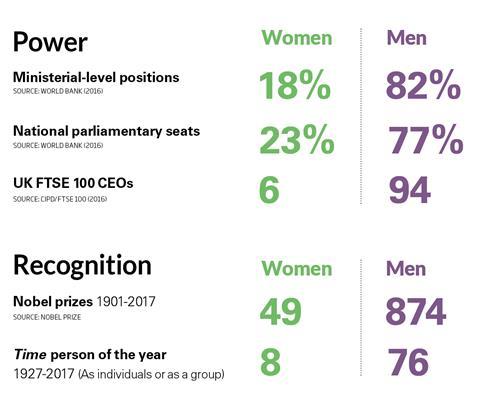
Even if we are not consciously playing the system, subconscious biases run deep. Lise Eliot studies differences between male and female brains at the Rosalind Franklin University in Chicago. It was years before she became aware that she was directing more attention to her male students, at the expense of female ones. “It’s only by being painfully aware that we can hope to change our behaviour,” she says. That means changing entrenched notions of what it means to be male or female, which is going to take an effort from both men and women. “If we can produce men with more child-centred values and women with more career-oriented values, we will move towards a society with equal opportunities,” says Hrdy.
Men also struggle to live up to the stereotypes of patriarchal societies
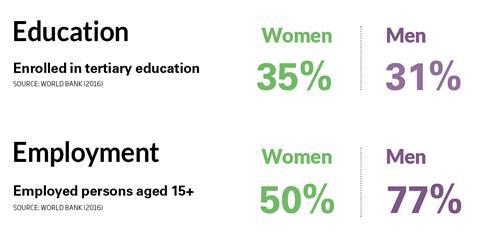
Even in a world where women and men are equally likely to be engineers and nurses, there will be barriers to equality. For starters, there are hidden disincentives for men to take more responsibility for childcare. A study by Jasmine Kelland at Plymouth University, UK, showed that part-time male workers are considered less competent and committed than any other group. Yet country comparisons suggest that encouraging fathers to be more present could help stem the incidence of rape and sexual assault (see “The hidden reasons why societies are violent towards women”).
Another challenge is female-female competition. A number of studies have looked at how this could be creating barriers for women at work. For instance, one found that female faculty in the Netherlands were more likely to be critical of female subordinates than male faculty were. An experimental study published last year suggests that high-ranking women are less likely than high-ranking men to collaborate with subordinates of the same gender. Elsewhere, an analysis of data on US workers found that women tended to prefer a male boss.
On the flip side, case studies show that with concerted effort, societies can learn to be less misogynistic. In Rajasthan, India, a quarter of married women experience violence from their partners. So three years ago, the Centre for Health and Social Justice in New Delhi orchestrated an intervention aimed at adolescent boys and young adult males, up to 25 years old, in 30 villages. In each case, one to two dozen males volunteered for training in gender equality, sexuality and violence.
Reviewing the impact in seven villages one year on, researchers found significant changes in knowledge and attitudes, and behavioural changes throughout the communities. In one village, all the girls were sent to school along with the boys as a result of the programme. In another, villagers had started a campaign against child marriage.
It’s just a couple of villages in one region, but the project shows that change is possible. And that it takes not just campaigns, awareness and laws but, more importantly, a profound transformation of biases and norms that both men and women hold on to.































No comments yet