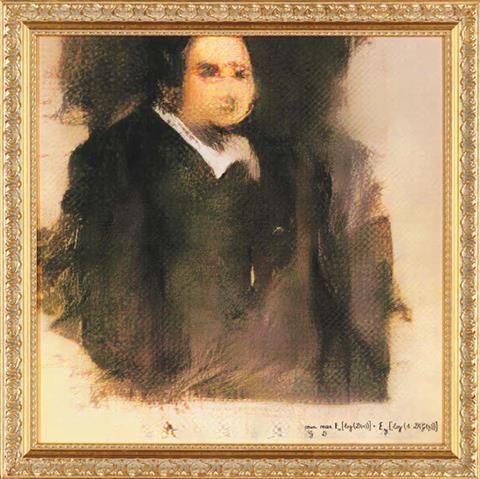
Stories abound of machines that are writing, painting and making music. Are we about to enter the creative singularity, asks Marcus du Sautoy. In October 2018, a portrait of Edmond Belamy sold at Christie’s in New York for $432,500, nearly 45 times its maximum estimated price. Nothing that out of the ordinary, perhaps. Except Belamy didn’t exist. He was the fictitious product of the artist’s mind – and the mind that created him wasn’t even human.
Signed in the corner by a formula that is part of the algorithm that created it, the portrait was the first artwork made by artificial intelligence brought to auction. There have been many similar seeming breakthroughs in AI creativity . In 2017, an AI wrote a continuation of the Harry Potter books by using machine learning to analyse the first seven volumes of J. K. Rowling’s output. The music for US singer Taryn Southern’s 2018 album I AM AI was bigged up as having been composed and produced entirely by machines. Back in 2016, SACEM, a French professional association in charge of artists’ rights, was the first to acknowledge an algorithm, the Artificial Intelligence Virtual Artist or AIVA , as a composer.
It fits into a common theme that anything we can do, AI can do – and probably better. But it is worth looking under the hood of all these creative outputs to understand how much the machines really are doing, and how much is just hype. Answering the question of whether AI can be creative isn’t easy – and raises fundamental questions about the nature and origins of human creativity.
It is fairly easy to discount or at least qualify many claims of AI creativity today. Just as, at the turn of the millennium, companies wishing to make it in the tech boom would indiscriminately tag.com on the end of their names, today businesses and individuals are using the labels “AI” or “Deep” to jump on a bandwagon. Much of what they are doing involves little more than data science and statistical number-crunching, and requires a lot of human intervention. The Harry Potter “writer”, for example, relied on a statistical analysis of J. K. Rowling’s existing oeuvre to suggest possibilities for the next words, but a human still chose which words to use. A new tale created by humans with the aid of some computational data science just isn’t as good a story, however. Similarly, Southern got more press traction for her album by bigging up the novelty of a contribution from AI.
AI art: Portrait of Edmond Belamy
Source: @obvious_art
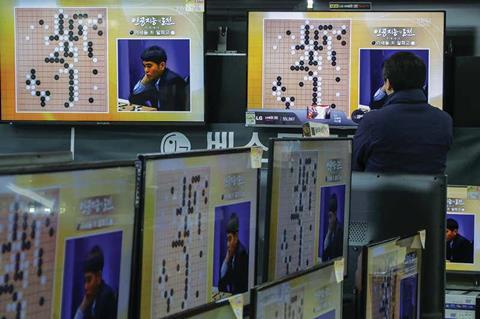
That isn’t to say that there aren’t some striking examples of AI potentially demonstrating true creativity. Take move 37 of the second game in the titanic battle of Go between the human champion Lee Sedol and the DeepMind algorithm AlphaGo in March 2016. Lee had already lost the first game , but many commentators felt this was because he had tried to play unconventionally to disrupt AlphaGo’s dependence on learning from previous games. But in the second game, it was AlphaGo that tore up the rule book.
Having made the 36th move, Lee had retired for a quick cigarette break. Not requiring the same stimulation, AlphaGo thought a while and then asked its human representative to place a black stone on the line five steps in from the edge of the board. Conventional wisdom says that during the early part of a Go game you play stones only on the outer four lines, and so prepare the ground for an assault on the central part of the board later.
Lee flinched when he returned and took in the move. But as the game played out, rather than being a mistake, that stone turned out to be the key to establishing control of the board, ensuring AlphaGo its second victory. Human competitors have since aped AlphaGo’s tactic to establish a competitive advantage. The AI’s discovery taught the world a new way to play an ancient game.
For me, this clears some of the key hurdles AI must leap if it is to be deemed truly creative. A basic definition of a creative act might be one that is new, surprising and has value. A computer can easily be programmed to produce novel outputs, but those second two criteria are more challenging. Who is being surprised, and how does one decide value?
“The value of AI might come not so much in making machines that act like humans, but stopping humans acting like machines”
The crucial 37th move in a Go game by the AI AlphaGo was hailed for its originality
Source: Seung Il Ryu/ZUMA Wire/Alamy Live News
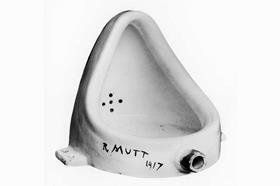
Move 37 certainly surprised the Go experts , and ultimately it had value: it won the game. It is easier to determine value in a game situation than in other creative spheres, however. An AI’s worth is generally judged by its ability to solve problems, but creating art isn’t a problem-solving activity. The monetary value of the Edmond Belamy portrait came about partly because it was created by an AI, not through some independent assessment of its artistic value. It is rather like Marcel Duchamp’s notorious artwork Fountain , submitted signed R. Mutt to a US art display in 1917. Consisting of a urinal lying on its back, it was valuable less for what it was, than for the questions it raised about what we mean by art.
The AlphaGo story demonstrates another way AI can help to create a sort of value, one that does apply in other areas of creative endeavour. It comes not so much in making machines that act like creative humans, but in stopping creative humans behaving like machines. We can get terribly stuck in our ways of thinking: as a Go player, your master would have slapped your wrist if you placed an early stone on the fifth line. An AI’s unprejudiced exploration of the terrain, meanwhile, can sometimes reveal new pinnacles of achievement. You may be at the top of Snowdon, thinking you have reached the ultimate height, but that is because you don’t know Mount Everest exists.
Musical Turing test
Many of the examples of music created by AI are still stuck in the foothills, comprising poor pastiches of Mozart or Beethoven’s works. But there are examples where code has helped us cross the valley to more interesting peaks. The Continuator, a jazz improvisor designed by François Pachet, director of the Spotify Creator Technology Research Lab, provides another example of how AI can help us escape the straitjacket of creative conventions . He trained his algorithm on the music played by jazz musicians. One of the standard modes of jazz is a call and response in which one player riffs and a second reacts. By analysing how one phrase of music mutated into another, the Continuator came up with its own responses to the riffs that make up a jazz musician’s sound world.
When musicians improvised with the Continuator, they were amazed. The algorithm was passing a kind of musical Turing test , responding in a way indistinguishable from a human improvisor. And its responses weren’t simply a mash-up of what had gone before: the musicians could hear the Continuator playing things that were recognisably connected with their style of performance, but which they never thought possible. It was taking the music to a new and unexpected level. It was as if the humans were playing in a huge hall but only in one small, illuminated corner – then the AI had thrown the lights on and shown them the whole space available to them. Pachet is currently working on Brazyle , an AI that aims to do something similar for Brazilian music.
Although novelty, surprise and value are three key components to measure if AI is being creative, I think a fourth element must also be introduced if we are going to herald real creativity in AI: originality of a truly independent nature. Lovelace herself raised it all those years ago as she wrote about Babbage’s machine. “It is desirable to guard against the possibility of exaggerated ideas that might arise as to the powers of the Analytical Engine,” she wrote . “The Analytical Engine has no pretensions whatever to originate anything. It can do whatever we know how to order it to perform.” Ultimately, she believed, you couldn’t get more out of the machine than you had put in.
This raises a crucial question: how much of any AI’s “creativity” is the creativity of the human coder rather than the code? Cameras heralded a new age of human creativity that can be seen displayed today in art museums across the world. But no one assigns the camera any part in the act of creativity.
But that is an imperfect analogy. Humans are machines running the instructions of a code, our DNA. Our parents are responsible for that code, yet we don’t regard ourselves as a mere vessel for the creativity of our parents. Part of how a child differentiates itself from its parents comes from its unique interaction with its environment. This interaction also shapes our creative abilities.
And that is exactly what is happening with AI. Machine learning allows code to change, mutate and update itself based on its interaction with new data: inputs from the environment. In creative terms, the potential result is shown by a work from the artist Ian Cheng displayed at the Serpentine Gallery in London in March 2018 . He started off with six artificial life forms, all called BOB and all written with the same code. But the parameters of each BOB’s code mutated depending on interactions with gallery visitors. At the end of the show, after months of different interactions, the six BOBs were very different beasts.
“How much are creative machines really doing – and how much is just hype?”
This shift from top-down to bottom-up coding gives code the chance to assert an independence from its architect. You could argue that Cheng was still the ultimate creative author, because he was the one who gave the code the possibility to evolve. But as the decisions made by code based on its interactions with the environment become harder and harder for its programmer or others to rationalise and explain, this standpoint becomes more questionable.
This captures a quality of creativity that perhaps has got lost in modern definitions of the term that stress novelty and the creation of value. These have their origins in self-help books written by the advertising executive Alex Osborn in the 1940s that aimed to realise creativity in individuals and so help them make money. Before this commercial attitude took over, creative activity was more about capturing our attempts to understand being in the world.
Machine learning taps into this earlier take on creativity, in that its output is an original expression of a machine’s interactions with an emerging digital world. But something fundamental is still missing: intentionality. What is driving the AI to blurt out a creative product? A human. Someone presses the print button, a person often chooses which algorithmic outputs to put in front of another human being. In that sense, AI doesn’t display the same intentionality in creativity as humans do. Can it ever?
Marcel Duchamp’s notorious urinal artwork Fountain sparked a debate over the meaning of art
Source: Duchamp: Fountain, 1917. Marcel Duchamp’s readymade sculpture, ‘Fountain,’ signed by R. Mutt, 1917/Alamy
To answer that question, we must first ask what drives our own urge for artistic creation. And for me, that is bound up with the hard problem of consciousness: the difficulty of explaining the true nature of felt experience in ourselves and other sentient beings. Because it is impossible to get inside each other’s heads to experience what another person’s pain or ecstasy feels like, we create works of art as a kind of functional MRI scan to reveal our conscious world and share it with others. A novel or a musical composition or a painting is our best way to help gain access to another person’s mind.
I can’t prove it, but I wonder whether true creativity and consciousness emerged at the same time in the human species. Perhaps only when we had consciousness did we start to wonder what was going on in the minds of others and want to share our own internal worlds – and begin to express ourselves creatively. If so, I think that true creativity in machines will only happen when they have a conscious world they want to convey to us.
I suspect that moment will be reached, but probably only in the distant future. When it does arrive, however, machine consciousness is likely to be very different from our own. And it will be AIs’ acts of artistic creativity that will be the best vehicle for accessing the strange world of what it is to be a conscious machine.
The complex politics of global warming results from numerous cofactors arising from the global economy’s dependence on carbon dioxide emitting fossil fuels; and because greenhouse gases such as CO methane and N2O (mostly from agriculture) cause global warming.
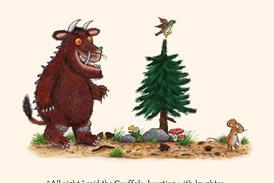
The makers of the children’s book The Gruffalo have drawn their characters practising social distancing to help children understand the regulations. Author Julia Donaldson and illustrator Axel Scheffler created the panels as a “light-hearted” way of spreading the message. They feature The Gruffalo, Stickman and The Smeds and The Smoos ...
Real-World Testing We loved the last Stumpjumper, but we wanted to make it an even more capable descender—this meant adding stiffness to the frame. To do it, we developed our own mountain-specific stiffness test that examined the connection between a rider’s hands and feet. When each get different signals, you ...



























No comments yet