By Anil Ananthaswamy and Kate Douglas

More than 600 million women live in countries where sexual violence is not a crime, according to the United Nations. Shocking as that is, it does mean that 3 billion women do have legal protection against the most extreme forms of sexual harassment.
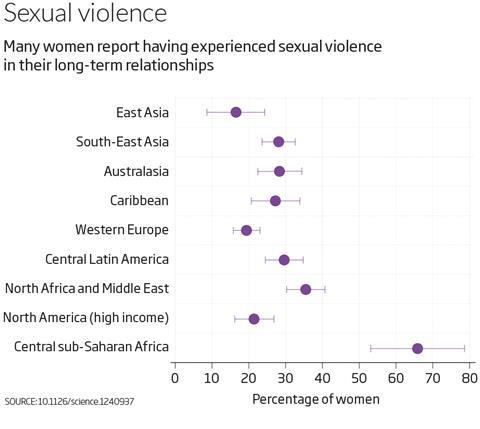
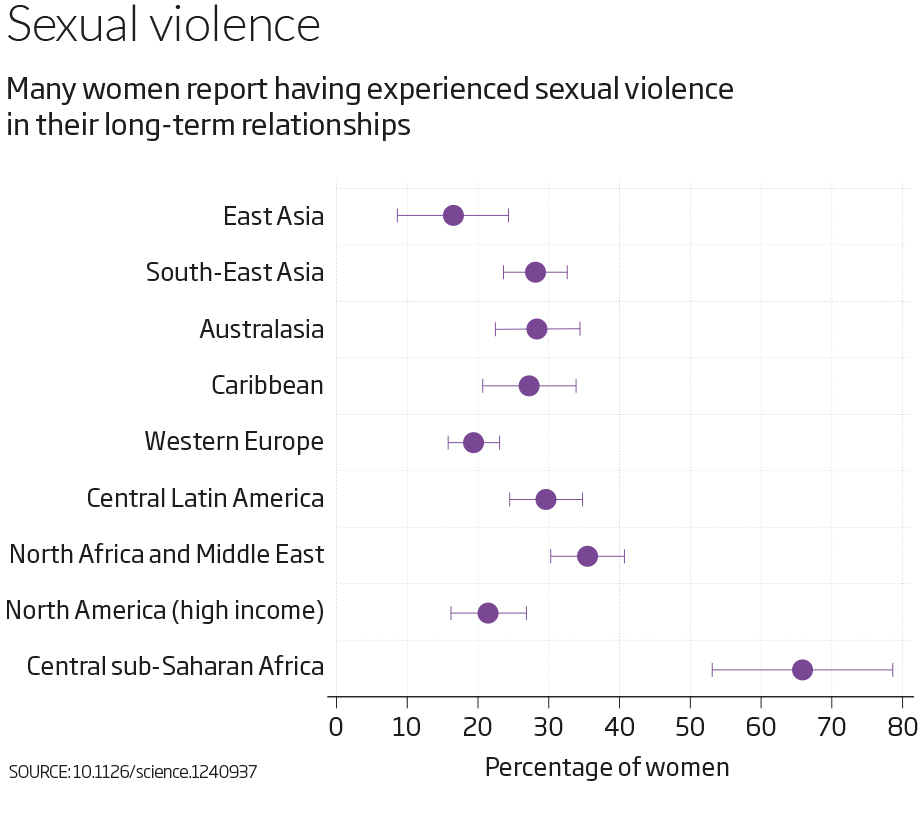
Despite this, figures for sexual abuse are alarmingly high. In the US, 15 per cent of women report having been raped in their lifetime. Worldwide, 30 per cent have experienced sexual violence in their relationships, ranging from 16 per cent in east Asia to 65 per cent in central sub-Saharan Africa (see diagram). Even the UN, whose stated mission is to defend fundamental human rights and promote social progress, has been plagued by allegations of rape, sexual exploitation and abuse.
So why is sexual violence so universal – and yet so variable in prevalence from place to place? An answer to the first question was proposed in the book A Natural History of Rape by biologist Randy Thornhill and anthropologist Craig Palmer. They argued that rape is an evolutionary adaptation that allows men to pass on more of their genes.
Their thesis caused public outrage. Tim Birkhead at the University of Sheffield, UK, called it “morally irresponsible”. And the facts speak against it. While one study found that women are 2.5 times more likely to become pregnant after rape than consensual sex, even when accounting for the use of contraception, the idea doesn’t account for the rape of men or children. What’s more, as primatologist Frans de Waal at Emory University, Atlanta, pointed out in a review of the book in The New York Times, if rape were an adaptation, rapists would be genetically different from non-rapists and would have more offspring. “Not a shred of evidence for these two requirements is present,” he wrote. Indeed, the book misrepresented the data it cited, according to an analysis by Jerry Coyne at the University of Chicago and Andrew Berry of Harvard University.
Can looking at how different societies compare give us more insight into the foundations of sexual violence? In its World report on violence and health, the World Health Organization cautions that we have only patchy data. Nevertheless, a measured analysis of what we do have reveals a few surprises. Sexual violence is not more prevalent in societies where men outnumber women, neither is it associated with more sexually liberal attitudes, or repressed sexuality in men.
As for the factors that do underpin it, anthropologist Peggy Reeves Sanday of the University of Pennsylvania and her team shed some light by looking at tribal societies. They classed 18 per cent of 156 societies as “rape prone”. The salient features they shared were high levels of violence in general, lack of parenting by fathers, ideologies of male toughness, dominance and competition, and low respect for women, including treating them as property and excluding them from public, economic and political life.
Reeves Sanday has spent decades in the field with some of the world’s least sexually aggressive societies, such as the Minangkabau of West Sumatra. Her work convinces her that if we want to reduce sexual violence, we must emulate matriarchies. “A matriarchal society isn’t the inverse of patriarchy, it’s egalitarian,” she says. “Where women and men cooperate in aspects of everyday life you do not have sexual abuse.” Similarly, the WHO report concludes that gender inequality is at the heart of sexual violence against women. “Sexual harassment is always about power,” says Cynthia Enloe, who studies gender and war at Clark University in Worcester, Massachusetts. “The only way to eliminate it is to tackle inequality.” In her book The Big Push she argues that we continue to modernise patriarchal ideas rather than overthrowing them.
To redress the balance, the WHO calls for fathers to become more involved in parenting, activism by both men and women, and tougher laws to reduce inequality in wages, education, divorce and property rights, among others.
It is easier said than done. But there is hope in the knowledge that cultures can change for the better. Just look at how the #MeToo movement is changing perceptions, says Reeves Sanday, with men in leadership positions starting to speak out too.






























No comments yet