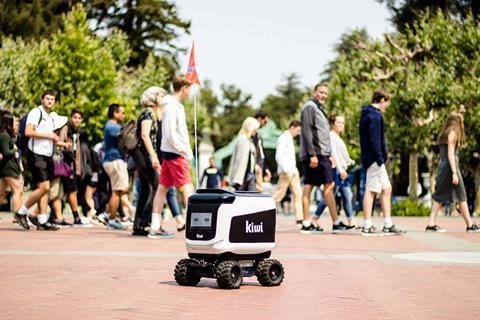
A FEW weeks ago, I almost killed a robot on the street. Distracted by my phone, I didn’t notice the small, wheeled entity about the size and shape of a rice cooker blocking my path. But then it slammed into my shin – or maybe I kicked it. When it looked up at me with digital cartoon eyes in the video screen of its face, I decided it was in more danger than I was. I could easily have knocked it down a hill.
The creature I had almost destroyed was a Kiwibot, property of Kiwi Campus, a company that has become famous in Berkeley for delivering food over short distances at very slow speeds.
The promise of the Kiwibots is a threat to food delivery workers everywhere, but in a way that is weirder and arguably worse than you might expect. The bots aren’t eliminating jobs, they are fragmenting jobs into tiny tasks that undermine people’s ability to find full-time work.
Students on the University of California campus order food from the Kiwibots, but human dispatchers pick it up, drive it to a cluster of the bots near campus (where I crashed into one) and pack it into the bots’ heated containers. Then the bots drive the food no more than half a mile before surrendering it to a human with the correct order code.
The company claims that its bots accomplish this task using sophisticated AI algorithms, but the little machines are in fact largely piloted by remote operators in Colombia who make $2 per hour – $13 less than minimum wage in Berkeley. With the help of these bots, delivery work has been torn to bits. One full-time job has become two pieces of “task work” managed by an online service.
This is a perfect illustration of how automation isn’t stealing our jobs. It is managing them. Taxi drivers who depend on algorithms to assign them customers have known this for a while. Recently, ride-share company Lyft rolled out a new feature that randomly assigned special “personal power zones” to Lyft drivers: a driver who picked up a ride in their zone would get a bonus fare.
The idea was to create an incentive for drivers to spread out across the city instead of circling around the downtown area, causing traffic jams. The problem? Drivers reported turning down rides to reach their zones, only to discover that the algorithm gave them no rides when they arrived. Or, worse, the zone bonus would suddenly decrease while the driver was en route to it.
“Kiwibots are a threat to food delivery workers in a way that is weirder and worse than you might expect”
This Lyft algorithm tweak cost drivers time and income. It is one of many reasons why ride-share drivers went on strike in May this year. It is also indicative of what happens when jobs are managed by automation: the day’s wages depend on a sometimes faulty system for assigning work.
Once hailed as “liberating” because it was so flexible, task work has become a nightmare in which people try to cobble together a full-time salary out of gigs that last minutes.
The irony is that many companies hide their task workers the way the Kiwibot does, by claiming that algorithms are carrying out jobs that are actually handled via outsourcing.
AI researchers Mary Gray and Siddharth Suri recently published a book about it called Ghost Work, which explores how companies use thousands of hidden task workers to train and supplement their machine-learning algorithms.
In 2017, I interviewed several ghost workers who spent their days working from home, picking up gigs from Google and Facebook through an online platform called Leapforce at the time. Each “job” lasted anywhere from seconds to a few minutes, and involved tasks like checking the accuracy of Google Search results. Similarly, companies use services like Amazon’s Mechanical Turk to train AI using data from thousands of gig workers.
Unfortunately, training AI with underpaid task workers can backfire. Some Mechanical Turk workers use bots to do extra tasks, so we are left with a house of mirrors where bots train bots and the results are predictably terrible.
The worst part is that most firms hid their dependence on ghost workers – by hiring them through third parties and by claiming their services or robots are automated. Robots have taken people’s jobs, but in name only.
Perhaps one day we will be struggling to find work in a world where robots truly can deliver food on their own, or drive cars. Maybe we will no longer need humans to hone the accuracy of machine-learning algorithms. But for now, and for the coming decades, corporations will use automation to dismantle our jobs piece by piece.
Annalee’s week
What are you reading?
Becky Chambers’s novel A Closed and Common Orbit, about an, AI getting used to having a human body.
What are you watching?
The second season of Killjoys, in which bounty hunters in space try to save a planet from evil corporate overlords.
What are you working on?
Predicting what comes after social media.

























No comments yet