















Astronomers use radio telescopes to explore the universe by detecting electromagnetic radiation emitted by objects in space.
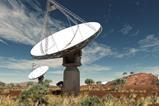
Radio wave receptors, or antennas, detect the relatively long wavelength (low frequency) radio waves that penetrate the Earth’s atmosphere. These radio signals have frequencies between about 30 MHz and 40 GHz, which is equivalent to, wavelengths from 10 m down to 7 mm. The SKA will observe at a frequency range from 70 MHz to 10 GHz which is equivalent to wavelengths of 4 m to 3 cm.
Radio telescopes provide alternative views of the Universe than those seen with an optical telescope and can reveal areas of space that may be obscured with cosmic dust.
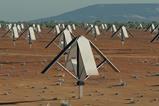
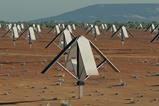
Radio telescopes can be used individually or they can be linked together to create a larger virtual telescope known as an interferometer. The SKA will be the world’s largest interferometer.





No comments yet