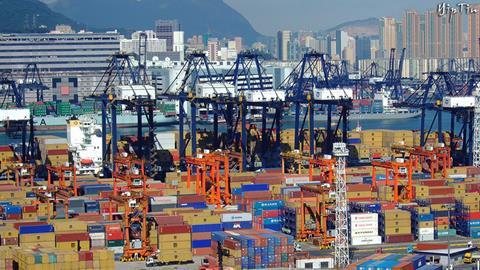
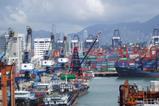
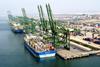
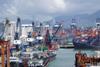
Hong Kong’s throughput was hit by a 40-day crane drivers’ strike in the first quarter of the year, which reduced the operational capacity of the port by around 20 per cent while it was continuing. Several vessels had to divert to competitor ports as a result.
Despite the fact that the operator, Hutchison Port Holdings, and the crane driver unions came to an agreement, the action epitomised the sort of problems that the port – the world’s largest container port for many years – faces in its attempt to retain its position. Hong Kong is one of the most expensive cities in the world, with some of the highest labour costs. And a mere few miles across the border in mainland China, port costs are substantially less.
Indeed, as production costs across China come under increasing scrutiny, the entire Pearl River Delta region is facing a manufacturing slow-down. This has seen volumes in neighbouring Shenzhen stagnate, too, and has led to calls for the two ports to enter into some form of co-operation agreement to create a mega-port complex.
This would see Shenzhen handling the more cost-sensitive cargo such as transshipment volumes, while Hong Kong would focus on providing higher value-added logistics services, to which its highly skilled workforce is more suited.
5. Pusan (Busan)
Throughput 2013: 17,680,000 teu – up 3.72 per cent on 2012 (17,046,000 teu)
South Korea’s largest port remains a major entrepôt for the Bohai Bay area of China, where carriers can interchange goods coming out of China and bound for Europe and the USA, as well as the not-insignificant export volumes coming out of South Korea and Japan. And the port also benefits from the Chinese Government’s ban on foreign carriers operating domestic cabotage services between Chinese ports (Container Shipping & Trade 1st Quarter 2014).
“We honestly believe that it would benefit Chinese ports if they relaxed this law and allowed us to carry out our own transshipment. We are forced to go to Busan as we cannot use Chinese ports for international relay,” Maersk Line’s Asia-Pacific head Tim Smith told Container Shipping & Trade.
Pusan fell just short of its stated 18 million teu volume target but remains on track to have some 55 per cent of its throughput as transshipment traffic, as its sets out to cement its position as the major container logistics provider in the region.
6. Ningbo
Throughput 2013: 16,770,000 teu – up 3.98 per cent on 2012 (16,175,000 teu)
The third largest port in mainland China, Ningbo’s rapid, double-digit growth seen over the past few years appears to have ended. In 2013 its growth was much more aligned to the rate seen in neighbouring Shanghai.
Currently under development at the port is an extension to the Meishan Container Terminal, after APM Terminals and Ningbo Port Group struck an agreement in 2012 to build and operate three berths. Scheduled to be operational by the end of this year, the new facility will add an extra 2.8 million teu of capacity to the port. It is likely to act almost as a dedicated terminal for Maersk Line – and probably for Mediterranean Shipping Co (MSC), too, if Chinese regulators approve the proposed 2M vessel sharing agreement between the two lines.
Currently Maersk’s various strings call at five different terminals in three different customs jurisdictions, resulting in significant extra haulage and other landside costs.
7. Qingdao
Throughput 2013: 15,520,000 teu – up 7.01 per cent on 2012 (14,503,000 teu)
With the highest rate of growth of the 10 largest ports in the world, Qingdao remains a stellar performer in China. The fact that its growth rate has slipped below the double digit mark demonstrates the scale of the slowdown that the country is experiencing in its export trades.
Qingdao Port (Group) Co, the owner of the port and majority owner of most of its terminals, this year decided to realise its success by partially floating some of its stock on the Hong Kong stock exchange. It operates its container terminals in conjunction with APM Terminals, DP World, Cosco Pacific, and China Merchants.
The port has set a target of handling 20 million teu by 2015 and 30 million teu by 2020. It has several berths and logistics facilities under construction in its Dongjiakou area to expand capacity, while in the longer term, the port authority has also earmarked the development of a 3 million teu capacity terminal in the Aoshan Bay area.
8. Guangzhou
Throughput 2013: 15,300,000 teu – up 5.18 per cent on 2012 (14,547,000 teu)
According to reports from China, Guangzhou Port Group, the port authority and major terminal operator in the southern port of Guangzhou, is looking to diversify into the logistics business as a way of capturing more cargo, with the development of barge and haulage hinterland transport operations.
A further boost to the port’s inland connectivity will take place in 2017 when a rail line linking into the country’s main network is due to be completed. This is important because the main growth driver of the port’s volumes has been its location at the heart of the Pearl River Delta manufacturing powerhouse. Recent years have, however, seen scores of factories depart the region in search of cheaper land, labour and administrative costs in the Chinese interior. To maintain its competitive edge, Guangzhou needs to follow the exporters.
9. Dubai
Throughput 2013: 13,641,000 teu – up 2.72 per cent on 2012 (13,280,000 teu)
The only port outside Asia in the top 10, Dubai is the major relay transshipment hub on the Asia-Europe trade, as well as being the gateway to the Gulf markets and – when international sanctions are eventually lifted – to the vast Iranian market.
The port is the home of DP World, which last year added another 1 million teu of much-needed capacity. This year it will add a further 4 million teu of capacity, in two phases, when it opens its Terminal 3 development.
Judging by year-to-date throughput, the additional capacity provided by Terminal 3 will be welcome. In the first six months of this year Dubai saw a throughput of 7.43 million teu, some 14.1 per cent above the same period last year.
10. Tianjin
Throughput 2013: 13,000,000 teu – up 5.67 per cent on 2012 (12,303,000 teu)
Tianjin Port (Group) Co has forecast that it will handle 14 million teu in 2014, which would represent a growth of 7.7 per cent over the throughput achieved in 2013. It is certainly an ambitious figure, given that few of China’s largest ports managed that sort of growth rate last year, and would generate revenue of some US$5.7 billion.
The company, which is owned by Hong Kong stock market-listed Tianjin Port Development, is also forecasting that it will hit the 20 million teu mark by 2017, although this might be considered too ambitious. Its chief growth strategy over the next few years is to improve the hinterland connections in order to capture cargo that is further into the Chinese interior.
In addition, last year it expanded the navigation channel into the port. This is expected to substantially reduce vessel turn-around times.