

















Magnetism has been fundamental for travelling and exploring our planet, with the Earth’s magnetic field guiding birds, bees and compass needles.
Furthermore, the effect of the Earth’s magnetic field on charged particles from the Sun has both shielded us from their harmful affects and entranced us with the beautiful aurorae lighting up the northern and southern polar skies.
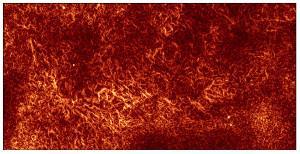
Through decades of astrophysical research we have established that magnetism is ubiquitous in our Universe, with interstellar gas, planets, stars and galaxies all showing the presence of magnetic fields. Generating magnetic fields on such large physical scales cannot be achieved through permanent magnets like those found in school science kits, but instead requires huge densities, volumes or motions of electrically charged material, such as the gas that pervades the Milky Way or the outflows of material from the energetic centres of galaxies.
The challenge and opportunities with magnetism
The challenge in studying cosmic magnetism is that, while stars and galaxies can be seen directly by the light they emit, magnetic fields are invisible even to the largest optical telescopes, instead requiring the detection of polarised radiation, radiation which exhibits the effects of magnetic fields.
One such example is synchrotron emission, produced when fast-moving (close to the speed of light) electrons, are trapped in magnetic fields, in a similar manner to the way planets are caught by the Sun’s gravity. If we see a heavenly body emitting synchrotron emission, we know that this object must be magnetic, and we can use its properties to determine how strong its magnetic field is and what direction a compass might point if it were near it.
Not all objects however are energetic enough to produce synchrotron emission and in these cases other mechanisms are utilised. The spectrally narrow emission from atoms and molecules can be split by the effects of magnetic fields, into two or more emission ‘lines’. This effect, known as “Zeeman Splitting” after the Dutch Physicist Pieter Zeeman, provides a direct measure of the magnetic environment of the atoms and molecules.
Another remarkable mechanism is when the polarised radiation from a distant object passes though the magnetic field of an intervening object and is altered. This effect, known as “Faraday rotation” after the British Scientist Michael Faraday, provides a measure of the magnetic environment of the intervening object (specifically the plane of polarisation is rotated by an angle proportional to the strength of the magnetic field and the density of the medium).
The difficultly with both these techniques is to truly understand the magnetic fields we are seeing we require many hundreds or even thousands of measurements, in the case of Faraday rotation, many distant galaxies or pulsars, lying directly behind the magnetised gas we want to study – like trying to make an environmental study of a large lake, dipping one’s finger in the water at one location is not enough!
Since the Square Kilometre Array (SKA) will be so much more sensitive than current telescopes, we can use it to revolutionise the study of magnetic fields in space. If we point the SKA at any part of the sky, we will detect the radio emission from thousands of distant faint galaxies, spread like grains of sand all over the sky. These galaxies will be so closely spaced that we can use the Faraday rotation of their polarised radio emission to make detailed studies of the magnetism of all sorts of foreground objects.
Even if we want to study a relatively small cloud of gas, there will be hundreds of background galaxies whose light shines through it, allowing us to build up a detailed picture of the cloud’s magnetism.
Through the mechanisms of Faraday rotation, Zeeman splitting and measuring the direct affects of magnetic fields on the polarised properties of radiation, we will be able to address many important unanswered questions: What is the shape and strength of the magnetic field in our Milky Way, and how does this compare to the magnetism in other galaxies? Is the Universe itself magnetic, and what role has this had on the formation of individual stars and galaxies? Where and how do the magnetic fields originate?
These are all questions for which the unique and fascinating capabilities of the SKA will provide incredible insight. We know that magnetism surrounds us, but with the SKA, we will transform our understanding of what these magnets look like, where they came from, and what role they have played in the evolving Universe.
Interesting fact
On Earth our magnetic field helps to channel the stream of particles from the Sun, known as the solar wind to the poles, forming the aurora seen in high northern and southern latitudes. These aurorae have also been observed on the outer gas giant planets as far out as Neptune, showing just how much of an influence the Solar wind has.
Topics
SKA Science
The SKA aims to solve some of the biggest questions in the field of astronomy. The unprecedented sensitivity of the thousands of individual radio receivers, combining to create the world’s largest radio telescope will give astronomers insight into the formation and evolution of the first stars and galaxies after the ...
- 1
 Currently
reading
Currently
reading
Cosmic Magnetism
- 3