

















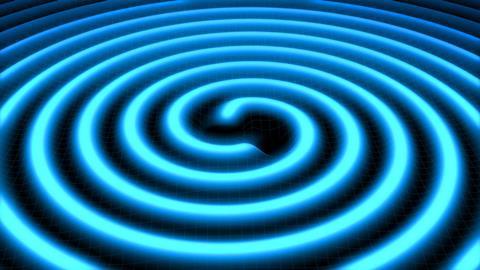
Was Einstein right about gravity?
The SKA will investigate the nature of gravity and challenge the theory of general relativity. Pulsars, the collapsed spinning cores of dead stars, will be monitored to search for gravitational waves – ripples in the fabric of space-time. The SKA will also use pulsars to test general relativity in extreme conditions, for example close to black holes.
A pulsar is a highly magnetised rotating neutron star – a gigantic nucleus consisting mainly of neutrons with a mass of 1.4 times the mass of the Sun but only as wide as a big city – about 20 km in diameter. A pulsar emits a radio beam along its magnetic axis. As the star rotates it acts like a cosmic lighthouse emitting an apparently pulsed signal when the beam is pointed in our direction. Because a pulsar has a huge amount of mass concentrated in a very small volume, it acts like a massive flywheel in space, and rotates very steadily. The observed pulses act therefore as the ticks of a natural clock which can be as precise as the best atomic clocks on Earth.
Through its sensitivity, sky and frequency coverage, the SKA will be able to investigate the strong-field realm of gravitational physics by finding and timing pulsars. About 50 years after the discovery of pulsars marked the beginning of a new era in fundamental physics, pulsars observed with the SKA have the potential to transform our understanding of gravitational physics.
Challenging Einstein
The phenomenal success of Isaac Newton’s theory of gravity in explaining the motions of bodies on the earth and in our solar system meant that the theory went unchallenged for about 300 years.
Only slowly did astronomers realise that certain deviations from the predicted motion of the planet Mercury could not be understood with Newton’s theory.
It took the genius of Albert Einstein to replace the traditional idea of the gravitational interaction between two bodies by predicting the effects of curved space-time. Suddenly, the orbit of Mercury could be explained, and Einstein’s simultaneous prediction of the deflection of starlight at the Sun was confirmed spectacularly during the solar eclipse in 1919 by the notable English scientist Arthur Eddington. Ever since, scientists have thought of new experiments to test Einstein’s general theory of relativity, as he called his theory of gravity, to ever better precision. So far, general relativity has passed all these tests with flying colours and not a single deviation from the theoretical prediction has been found in the experiments.
Quantum mechanics, developed at around the same time as Einstein’s general relativity, is known to describe nature successfully at the sub-atomic level. It has been proposed that a grand unified theory will involve the unification of general relativity with quantum mechanics.
‘Classical’ general relativity, which is the theory developed by Einstein in 1915, is a theory where gravitational fields are continuous entities in nature. They also represent the geometric properties of 4-dimensional spacetime. In quantum mechanics, fields are discontinuous and are defined by ‘quanta’. So, there is no analogue in conventional quantum mechanics for the gravitational field, even though the other three fundamental forces have now been described as ‘quantum fields’ after considerable work in the 1960-1980s. Quantum mechanics is incompatible with general relativity because in quantum field theory, forces act locally through the exchange of well-defined quanta.
Although such a marriage of these two great scientific fields is potentially some way off, we can expect that this theory of quantum gravity may produce somewhat different predictions than general relativity. But how can we measure such deviations? How can we test when – if at all – general relativity fails?
We have to assume that so far we have not probed gravitational fields that are strong enough to show deviations from general relativity’s prediction. Tests in the solar system are made under weak-field conditions. Strong-field tests of gravity that will be carried out using pulsars and the SKA will provide some of the most stringent tests ever made.
How will the SKA be able to detect gravity, when it is a radio telescope?
The SKA will be able to indirectly measure the effects of gravity on objects in the Universe. Objects like Pulsars, the fast spinning remnants of supernova explosions, and their more exotic cousins, the Black Holes, which are the densest objects in the Universe, exert huge gravitational effects on nearby objects, but also, through the electromagnetic radiation they “beam out” in the case of pulsars, can be detected by radio telescopes like the SKA.
These beams act like a lighthouse, and whilst the pulsars spin at sometimes incredibly fast rates, radio telescopes are able to detect these pulses and accurately time them. Pulsars are some of the most accurate clocks in the Universe, and it is the accuracy, and the SKA’s ability to detect even the most subtle variations in this, which will hopefully enable this breakthrough in science. The SKA will scan for pulsars near to black holes and look at the gravitational influences of these two objects, looking for the miniscule perturbations in the fabric of space-time itself which would be caused.
These perturbations, known as gravitational waves are the subject of extensive research by both ground and space based telescopes. They have been detected for the past 30 years from observations of pulsars in the radio frequency, but up to the early part of the 21st century, larger scale gravitational waves, permeating through all of space, possibly caused by the collision of two black holes, were still only theoretical.
The SKA’s sensitive instruments, will attempt to look at these huge scale gravitational events in an attempt to refine and test Einstein’s theories to the absolute limit.
Some Interesting Facts
- For something theoretically the size of the Earth to become a black hole, it would need to shrink to the size of a large toy marble
- The Sun, when it uses all of its nuclear fuels will expand and most likely form a planetary nebula, it is too small to become a supernova and then a neutron star or black hole
- The first pulsars were found in the UK in the 1960s by a PhD student (Jocelyn Bell Burnell) and were known at the time as LGM (Little Green Men)
SKA Science
The SKA aims to solve some of the biggest questions in the field of astronomy. The unprecedented sensitivity of the thousands of individual radio receivers, combining to create the world’s largest radio telescope will give astronomers insight into the formation and evolution of the first stars and galaxies after the ...
- 1
- 2
 Currently
reading
Currently
reading
Strong-Field Tests of Gravity