LATE one evening, at a jazz festival in the remote village of Saariselkä in northern Finland, Unto Laine and his friends decided to go outside to watch the aurora borealis and listen to the silence.
It was -35°C and completely still as the Northern Lights played overhead. “We all started to listen without talking, without moving and almost even without breathing,” says Laine. They wanted to hear how quiet it could be with no traffic, no wind and everyone asleep.
But to their surprise, the silence wasn’t total. The group became aware of a faint background sound, a sort of hissing that seemed to change in synchrony with the movements of the aurora.
“We started to discuss whether these sounds could be caused by the aurora and we all agreed – no way,” says Laine. “The aurora is so high that the sounds created there could not be audible on the ground.”
That was in 1990. Laine forgot about the rustling aurora until he revisited the jazz festival in 1999. He once again found himself puzzled by the mysterious sound. He may not have been the first person to be intrigued by this phenomenon, but he was perhaps best placed to solve it.
Laine studies psychoacoustics – the science of sound and how we perceive it – at Aalto University in Helsinki. He has now spent much of the past 20 years fighting to prove that the aurora isn’t simply a feast for the eyes; there is magic for the ears as well.
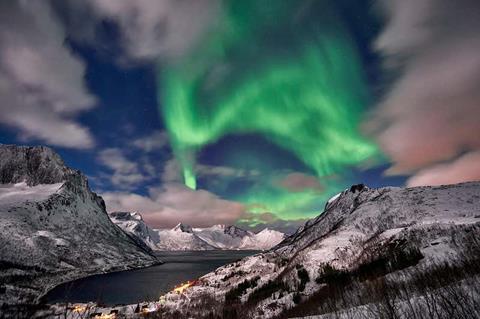
The Northern Lights occur when charged particles from the sun collide with Earth’s atmosphere. At the poles, the orientation of our planet’s magnetic field can allow these particles to penetrate the upper layers of air and excite gas molecules 80 kilometres over our heads. These molecules then get rid of their excess energy in the form of light: green or red for oxygen, blue or purple for nitrogen.
Most aurora watchers never hear anything. Sounds are lost in background noise, like traffic and people talking and taking pictures. Few seek to watch in perfect silence as Laine’s group did.
But some clearly had. Laine found a long history of accounts of auroral sounds from indigenous peoples in northerly latitudes, as well as scientific reports going back more than 300 years. A list compiled in 1931 quotes one listener hearing “a swishing or rustle, like that of a silken skirt”, another said it was “the sound made when a couple of slices of good fat bacon are dropped in a red-hot pan”, a third compared auroral sounds to “a flock of birds flying close to one’s head”. Others described “a very curious faint whistling sound” and even “loud reports similar to rifle cracks”.
Physicists looking to replicate these observations weren’t so lucky. Auroral sounds were problematic for two reasons, says Dirk Lummerzheim at the University of Alaska. “Every attempt to record or observe that sound with technical equipment had failed,” says Lummerzheim. “And there was no known mechanism that could explain the sound that people reported.”
Seen but not heard
That led some to suggest that the sound was an auditory illusion caused by seeing the aurora, or even the result of synaesthesia – in which the activation of one sense can trigger another. To Laine, this was dismissing observations simply because they were hard to explain.
“What if the Canadian First Nations, Inuits, the Sami people and those minorities living in northern Siberia are right?” asks Laine. “Instead of blaming the observers for making errors, or having synaesthesia, shouldn’t we scientists study this phenomenon and solve the mystery?”
In 2000, Laine started a project to do just that with Finland’s Sodankylä Geophysical Observatory, a centre of expertise on the aurora borealis. A major goal was to record the sound of the aurora for the first time. This was challenging, because it wasn’t clear what the sound was, or where it was coming from.
“It took a long time to discover all the ambient sound sources and to reject them,” says Laine. These difficulties, plus the challenge of finding funding and a lack of wider interest, meant that it wasn’t until 2010 that Laine captured his first recording of auroral sounds.
For those who had taken auroral sounds seriously, the recordings contained a surprise. Many had speculated that the noises were due to ground objects acting as electromagnetic receivers, mini aerials vibrating in response to the great light show overhead. Laine was sceptical. “Observers have talked for hundreds of years about these sounds being ‘in the air’, not on the ground or in treetops,” he says. His psychoacoustics background encouraged him to believe these reports.
“Observers had talked for a long time about these strange noises in the air”
Laine’s findings ultimately backed them up: the sounds were coming from the air itself, from an altitude of less than 100 metres. “Human hearing is very good at localisation of sound sources, and this part of the reports had not been taken seriously,” he says.
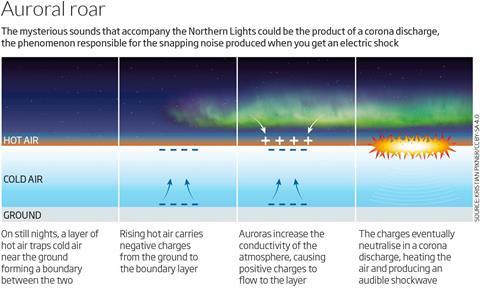
So why do these auroral sounds arise? Laine believes their origin lies in a phenomenon known as corona discharge, similar to the process responsible for the audible spark of a static shock. These discharges are often seen around high-voltage electrical equipment, in the form of a blue glow around pointed metal objects, often accompanied by a buzzing sound.
To generate the kind of voltages required, you need to build up a lot of positive and negative charge in very close proximity. Laine’s proposal is that this can happen on very still evenings, when the frozen ground begins to cool the air immediately above it. This results in a high layer of warm air, with several hundred metres of cool air trapped below it. Negative ions close to the ground rise up to the lower layer of this interface, known as an inversion layer, but are prevented from rising above it. Meanwhile, positive ions settle on its upper surface. This electric potential, already significant, is increased further by the aurora, says Laine, up until the point where a sudden corona discharge happens. “This produces ultraviolet radiation, magnetic field pulses – and sounds.”
This theory elegantly accounts for why the sounds occur only during particular weather conditions. Without an inversion layer, there are no sounds, however bright the auroral display. And when the sounds do appear, they are always at similar altitudes.
“Laine’s proposed mechanism does seem plausible,” says Daniel Whiter, a space physicist at the University of Southampton, UK. But not everybody is convinced. Most scientists still ignore auroral sound, says Lummerzheim, and those who do accept it tend to favour synaesthesia as an explanation. “What is needed is for other researchers to try to duplicate Laine’s experiment and design independent experiments to test the inversion layer hypothesis,” says Lummerzheim.
However, Laine is delighted at the progress towards vindicating all those reports previously dismissed as illusory. “A new page has turned in this long history,” he says. “Those who made valid observations of these sounds can now be proud.”


























No comments yet