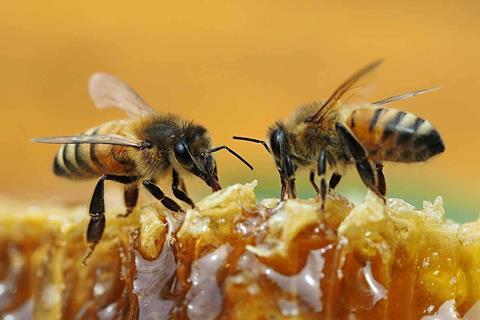
They found that the ratio of two types of lead atoms, lead-206 and lead-208, varied in the samples depending on where the hives were. Honey that came from land that is used heavily by humans had a different signature to honey that came from rural areas. This is probably because the lead comes from different sources, perhaps the burning of fuel in urban areas and from geological sources in the countryside. Rocks naturally give off tiny amounts of lead over time.
The levels of lead found in the honey were well below recommended limits, meaning it is safe to eat, says Smith.
At the Goldschmidt geochemistry conference in Barcelona, this week Smith reported that honey can provide estimates of environmental lead concentrations that are similar in accuracy to those obtained by more established sampling methods, such as looking at topsoil and particles in the air. She also measured bee tissue and found it matched too. “The gradient matches beautifully,” she says.
This means honey could be a useful tool in places that don’t have established infrastructure for pollution monitoring, says Smith.
The use of bees for monitoring environmental contamination is potentially better than existing methods, says Mark Taylor at Macquarie University in Australia who undertook similar research on honey in a mining town.
The bees forage over a large area, flying up to nine kilometres from their hive, and so reflect contamination from a bigger area than air sampling for a single station, says Taylor. “Multiple beehives across an area can therefore provide more detailed coverage of contaminants in the environment.”
Plus, if contaminants are found in bee tissue and honey, that confirms that they are getting into the food chain, which can’t be shown by simply looking at the air and soil.




















No comments yet