













Geordie Torr visits San Juan County, Utah, to sample the incredible archaeological legacy of the ancestral Puebloan people.
When we think about archaeology and the Americas, our thoughts rarely get past the big three southern civilisations: the Incas, Aztecs and Maya. And that’s hardly surprising, given their incredibly impressive architectural legacy: from Macchu Picchu to Tikal and Chichen Itza.
But North America has an even longer history of colonisation, and in the Four Corners region of the southwestern USA, where the states of Utah, Colorado, Arizona and New Mexico come together, there is a veritable treasure trove of archaeological sites. The best known are, of course, the remarkable cliff dwellings of Mesa Verde and Chaco Canyon, but this whole region is absolutely teeming with rock art and ruins.
From basketmakers to potters
The first people are thought to have arrived in the Four Corners area around 10,000–12,000 years ago. These so-called ‘archaic’ peoples were essentially wandering hunter–gatherers.
In around 1000 BC, they began cultivating maize and squash. Agriculture allowed them to settle down and begin building shelters, and this settled lifestyle, in turn, allowed them to develop their handicrafts. Basket weaving became extremely sophisticated and for this reason, the people from this time period are known as ‘basketmakers’.
Towards the end of the so-called Basketmaker period, in around 750 AD, they started making pottery. Not long after, they also began to cultivate protein-rich beans and were living in stable villages. These people were once known as the Anasazi, but today, they are more commonly called ancestral Puebloans (see What’s in a name?).
By about the 11th century, the ancestral Puebloans’ architecture had developed to the point where they were building sophisticated multi-storey cliff dwellings and apartment houses, some of which reached five storeys in height and contained hundreds of rooms. They had also perfected a variety of methods of irrigation and water storage.
However, their efforts to keep drought at bay were sorely tested towards the end of the 13th century, when a long and devastating drought took hold. Thousands died and there is evidence of bitter conflict – among the people themselves and probably also with nomadic groups such as the Utes, who were arriving in the area around that time – and even cannibalism.
They began migrating south en masse – it’s unclear exactly what the motivation was, although there were probably several factors at work – and by around 1300, the entire population had gone, leaving behind an archaeological legacy that is stunning in its breadth and sophistication. As well as architectural wonders such as Mesa Verde and Chaco Canyon, they frequently left behind items such as baskets and cooking pots – probably because they were too bulky to carry.
Ruins and rock art
At the height of the ancestral Puebloans’ civilisation, there could have been as many as 250,000 people living in the Four Corners region; by comparison, San Juan County, in the southeastern corner of Utah, currently has a population of just 14,000 people.
The ancient population density is reflected in the ubiquity of archaeological sites scattered around the Four Corners. There are many sites that you can easily visit yourself – for example, Mesa Verde and Chaco Canyon in Colorado and New Mexico respectively, and Hovenweep National Monument and Newspaper Rock in San Juan County. Others, such as Ruin Park, require off-road vehicles or some hiking.
Alternatively, you can hire a local guide and head out into the back country. Vaughn Hadenfeldt, who runs Far Out Expeditions, has spent more than 20 years exploring and guiding in the Four Corners. Over that period, he has built up an unparalleled knowledge of archaeological sites in the region.
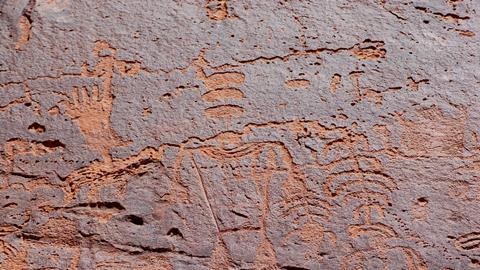
At many of these sites, the rock art is associated with prehistoric travel routes. Hadenfeldt takes me out along an old uranium prospecting road to the base of a huge flat-topped plateau called Cedar Mesa. Here there are numerous boulders into which an impressive array of figures and designs have been pecked. ‘These people were travelling through – there aren’t any long-term habitation sites here,’ Hadenfeldt explains. ‘If you wanted to gain access to Cedar Mesa, there are a couple of prehistoric routes that will lead you up to the top. Once you get out of this site, you can walk a long distance and not come across any rock art.’
Here, the rock art has almost exclusively been placed on areas where there is a black patina on the surface of the rock. Known as ‘desert varnish’, it’s a mixture of manganese and iron oxide. It was once thought that it leached out from inside the rock, but it’s now generally agreed that it has an external origin. However, there is still some debate over whether it simply accretes on the rock or whether bacteria are concentrating the manganese on the rock surface.
During the off season, Hadenfeldt travels around looking for new sites. ‘Once you’ve figured out a particular region, and how people related to that landscape, oftentimes, as you’re walking along, you can go, “I bet there’s rock art over there”,’ he explains. ‘If there’s a big black patinated surface on a rock, I’ll definitely check it out.’ And there’s still plenty of undiscovered material out there. ‘I’m always astounded at what there is left still to see here,’ he says. ‘We have literally thousands and thousands of sites. On public land in the west, certainly in Utah, only about ten per cent of the archaeology has been recorded.’
Indeed, when it comes to artefacts, new material is constantly appearing. The underlying geology here is almost exclusively sedimentary – the sandstone and limestone of the Colorado Plateau – and as it erodes, it leaves behind a light, soft soil with a consistency similar to talcum powder. Each year, when the rains come, another layer of this sediment is washed away, exposing new material. ‘When we go through these wet periods, more stuff is constantly churning up to the surface,’ Hadenfeldt says.
Exquisitely decorated pots are among the more common finds, but there is also a wealth of perishable material just waiting to be discovered. ‘The preservation here is so good,’ Hadenfeldt explains. ‘Everywhere else, most things have rotted away, but we have great preservation here, so we still find perishable materials.’
The best place to see this sort of material is the Edge of the Cedars Museum in Blanding. Built beside the remains of a pre-Columbian Puebloan village, the museum houses the largest collection of ancestral Puebloan pottery and other artefacts in the Four Corners Region. As well as the obligatory displays of pottery, the museum features a remarkable collection of blankets, sandals and other perishable goods; the highlight is a stunning macaw-feather sash.
Although the museum’s collection is constantly growing, most of the new material now comes from random discoveries; very little active archaeological work is currently being carried out in the region. ‘We don’t excavate very much any more unless it’s necessary to do a total documentation because something’s going to be destroyed by a road or a dam project,’ explains Teri Paul, the museum’s director. ‘One of the main reasons for this is that we’re waiting for better technology that’s less destructive. But it’s also very expensive: in terms of people and time but also, once you’ve excavated, you have all of these objects that you have to take care of. Where do you put them? Who is going to take care of them? And where are you going to get the money to take care of them? And then, if you’ve excavated, you end up with a beautiful stone building – and either you backfill it to protect it, which is what most of us favour, or you leave it open for the public and it deteriorates, or you actively protect it, which is extremely expensive.’
Endangered artefacts
Curation is but one of the many problems affecting this archaeological storehouse. Looting, in particular, has long been a serious issue. ‘Archaeological looting is a very big problem in the southwest. And it’s ongoing – all you have to do is look on eBay to see the extent of the problem,’ Paul says. ‘Unfortunately, in the USA, antiquities on private land don’t belong to the nation, they belong to the private individual,’ Hadenfeldt continues. This creates an enormous loophole, through which the looters can step with impunity: ‘How can you prove that someone dug up a pot on public land unless you actually catch them?’ Many serious pothunters now simply lease large tracts of private land and excavate there.
‘A lot of our sites are also really suffering just from visitation levels,’ says Hadenfeldt. ‘If you get hundreds of people tromping up into a site, particularly people without any background or understanding of the fragility of archaeological sites, they might be doing things that they don’t even realise are detrimental to the site. That’s probably our biggest issue in a lot of places today.
‘New technology is a problem, too,’ he continues. ‘You get people visiting sites, putting the GPS coordinates on the web, and all of a sudden you have visitation booming at places where, in the past, you would rarely have seen a footprint.’ In order to safeguard the locations of the back-country sites that he has identified – and, indeed, the sites themselves – Hadenfeldt doesn’t allow participants on his tours to bring their GPS units with them.
Indoors versus outdoor museums
Hiking guide Vaughn Hadenfeldt is a strong advocate of an idea known as the outdoor museum. ‘It’s a crazy concept and probably a pie in the sky outlook on things, but when I visit sites, I think that the stuff should remain in the site,’ he explains. ‘Unless it’s something highly unusual, I’m willing to leave it for the enjoyment of the next person.
‘I don’t have the desire to collect,’ he continues. ‘I love to find the stuff; I love to look at it, photograph it, draw it, whatever, but then put it back. I’ve found lots of pretty wonderful artefacts in situ out here – I think I have 18 pots that I’ve found. People say to me, “Okay Vaughn, so you find this beautiful pot sitting on a ledge, well, the next guy who comes along is going to take it.” I guess that’s a risk I’m willing to take.’
As Hadenfeldt points out, museums have huge collections of artefacts already – more than they can study. ‘Do we need more pots sitting in the backrooms of museums? I don’t think we do unless they tell us something new.’
Hadenfeldt believes so strongly in the concept that he once left a project that he had helped to set up to record rock art at Cedar Point because a ranger was collecting artefacts that he had found.
There are exceptions, however. When he finds something particularly interesting – that he knows isn’t already represented in the collections – he will alert the authorities to it. There’s a perfect example of this in the Edge of the Cedars Museum – a beautiful scallop-shell pendant that must have come from a great distance away.
What’s in a name?
There is some controversy over exactly what to call the people who inhabited the cliff dwellings of southeastern Utah and the adjacent states. The widely used term Anasazi is now considered to mean ‘ancient people’, but the original derivation, from the Navajo, is ‘enemy ancestors’ or ‘ancient people who are not us’. Due at least in part to historical conflicts between the Navajo and Pueblo people, the term Anasazi is considered to be offensive by many.
In recent years, a new terminology has been used, and these people are now known as ‘ancestral Puebloans’. However, this, in itself, causes problems as ‘pueblo’ is a Spanish word – and of course there are some unpleasant historical connotations relating to the treatment of the original inhabitants of the region by the Spanish. Indeed, reports submitted for review by the Navajo Nation Historic Preservation Department are rejected if they include use of the term.
The obvious answer to this conundrum would be to use a word derived from the language of the modern Pueblo peoples, but there are several different languages to choose from. The modern Hopi use the word Hisatsinom (‘ancient people’), and this term has found some favour, but it hasn’t entered wider usage as this would appear to favour the Hopi over other Pueblo peoples.

No comments yet