| Parameter | Specification |
|---|
| Frequency range |
70 mhz to 10 ghz |
| Sensitivity area / system temp |
5 000 m²/k (400 μjy in 1 minute) between 70 and 300 mhz |
| Survey figure-of-merit |
4×10⁷ – 2×10¹⁰ m4k-2 deg2 depending on sensortechnology and frequency |
| Field-of-view |
200 square degrees between 70 and 300 mhz |
| 1-200 square degrees between 0.3 and 1 ghz |
| 1 square degree maximum between 1 and 10 ghz |
| Angular resolution |
<0.1 arcsecond |
| Instantaneous bandwidth |
Band centre ± 50% |
| Spectral (frequency) channels |
16 384 per band per baseline |
| Calibrated polarisation purity |
10 000:1 |
| Synthesised image dynamic range |
>1 000 000 |
| Imaging processor computation |
1015 operations/second |
| Final processed data output |
10 gb/second |
It’s not surprising that the medical sector is a key market for AV. Communication of ideas, methods, rare and unusual cases and expertise is crucial to the success and advancement of this critical field. Anything that can be done to make this communication faster, to provide higher quality images and to promote discussion between wider numbers of medical professionals and students is incredibly important.
But the field is also very specialised. It is a science and the needs, concerns and approaches of the industry may not necessarily be understood by those not practised in the field. It is exactly this fact that has enabled Dr Wim Van Renterghem, a qualified medical doctor who has developed a personal interest in multimedia and film, to carve a very specialised niche in this field.
I could see production companies making medical surgical videos but not showing what should be shown and I saw doctors making their own medical home movies with good educational results but very poor technical levels
Wim Van Renterghem, mediaAVentures
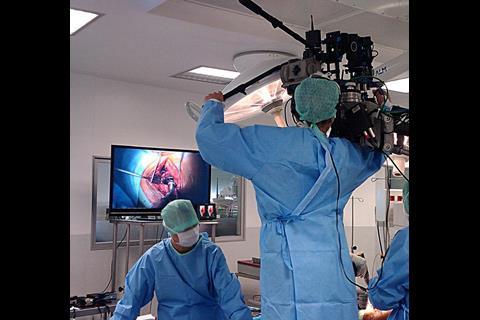
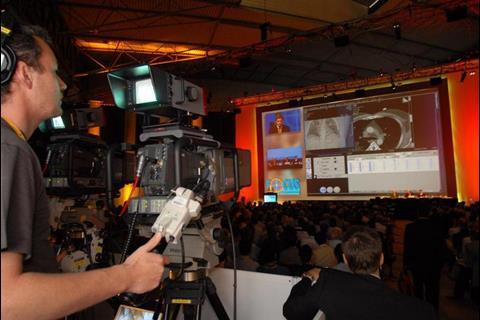
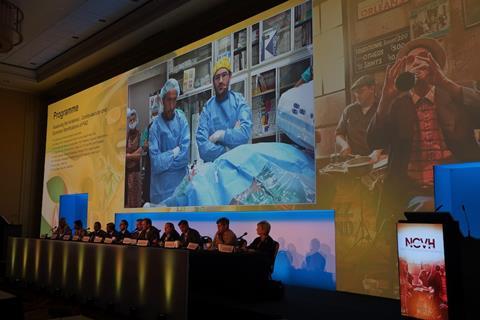
Dr Van Renterghem founded mediAVentures, a company that specialises in transmission of HD live surgery and provides AV support to medical congresses.
He initially started in the field in 1989, operating on his own before expanding in 1994. The company now employs 15 staff, is managed by three medical doctors, and has pulled in professional camera people and AV technicians.
While studying as a medical doctor in Ghent, Belgium, Van Renterghem always had an interest in multimedia, film and photography. It was an encounter with a badly produced medical video that made him realise there was an opportunity to combine medical scientific knowledge with high definition video and technical skills.ρΤ
SKA telescope to focus on five big questions
An array of thousands of receptors will extend out to distances of 3,000 km from a central core region. The SKA will address fundamental unanswered questions about our Universe including how the first stars and galaxies formed after the Big Bang, how galaxies have evolved since then, the role of magnetism in the cosmos, the nature of gravity, and the search for life beyond Earth.
Sixty seven organisations in 20 countries, together with industry partners, are participating in the scientific and technical design of the SKA telescope which will be located in either Australia - New Zealand or Southern Africa extending to the Indian Ocean Islands. The target construction cost is €1,500 million and construction is scheduled to start in 2016.
The SKA will give astronomers insight into the formation and evolution of the first stars and galaxies after the Big Bang, the role of cosmic magnetism, the nature of gravity, and possibly life beyond Earth. If history is any guide, the SKA will make many more discoveries than we can imagine today.
Radio astronomy has produced some of the greatest discoveries of the 20th century. Central to these discoveries have been innovations in technology pushing the observational frontiers of sensitivity as well as spatial, temporal and spectral resolution. One such innovation in technology – radio interferometry – was awarded a Nobel Prize for Physics. The SKA will carry on this tradition of innovation by combining fundamental developments in radio frequency technology, information technology and high-performance computing.
The SKA will be the world’s premier imaging and surveying telescope with a combination of unprecedented versatility and sensitivity that will open up new windows of discovery.
The SKA key science projects
Five key science projects have been selected:
- How do galaxies evolve and what is dark energy?
The acceleration in the expansion of the Universe has been attributed to a mysterious dark energy. The SKA will investigate this expansion after the Big Bang by mapping the cosmic distribution of hydrogen.
- Was Einstein right about gravity?
The SKA will investigate the nature of gravity and challenge the theory of general relativity.
- What generates the giant magnetic fields in space?
The SKA will create three-dimensional maps of cosmic magnets to understand how they stabilise galaxies, influence the formation of stars and planets, and regulate solar and stellar activity.
- How were the first black holes and stars formed?
The SKA will look back to the Dark Ages, a time before the Universe lit up, to discover how the earliest black holes and stars were formed.
The SKA will be able to detect very weak extraterrestrial signals and will search for complex molecules, the building blocks of life, in space.

























No comments yet