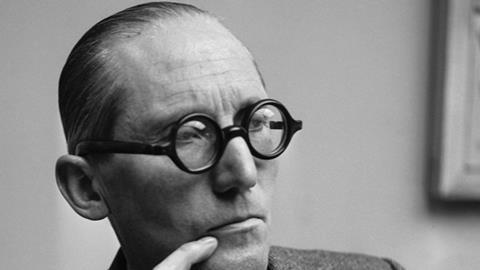
Charles-Edouard Jeanneret-Gris was born in La Chaux de Fonds, Switzerland, 1887. Trained as an artist, he travelled extensively through Germany and the East. In Paris he studied under Auguste Perret and absorbed the cultural and artistic life of the city. During this period he developed a keen interest in the synthesis of the various arts. Jeanneret-Gris adopted the name Le Corbusier in the early 1920s.
Le Corbusier’s early work was related to nature, but as his ideas matured, he developed the Maison-Domino, a basic building prototype for mass production with free-standing pillars and rigid floors. In 1917 he settled in Paris where he issued his book Vers une architecture [Towards a New Architecture], based on his earlier articles in L’Esprit Nouveau.
From 1922 Le Corbusier worked with his cousin Pierre Jeanneret. During this time, Le Corbusier’s ideas began to take physical form, mainly as houses which he created as “a machine for living in” and which incorporated his trademark five points of architecture.
During World War II, Le Corbusier produced little beyond some theories on his utopian ideals and on his modular building scale. In 1947, he started his Unite d’habitation. Although relieved with sculptural roof-lines and highly colored walls, these massive post-war dwelling blocks received justifiable criticism.
Le Corbusier’s post-war buildings rejected his earlier industrial forms and utilized vernacular materials, brute concrete and articulated structure. Near the end of his career he worked on several projects in India, which utilized brutal materials and sculptural forms. In these buildings he readopted the recessed structural column, the expressive staircase, and the flat undecorated plane of his celebrated five points of architecture.
Le Corbusier did not fare well in international competition, but he produced town-planning schemes for many parts of the world, often as an adjunct to a lecture tour. In these schemes the vehicular and pedestrian zones and the functional zones of the settlements were always emphasized.
















No comments yet