Campaigners want to keep Haverfordwest castle grounds open to the public by securing village green status.
That would stop the site being used for private redevelopment, such as recent interest in setting up a hotel.
Haverfordwest Town Council is behind the application but Pembrokeshire County Council said the plan was flawed and wants to sell off the land.
Haverfordwest castle is what the town has been built around - it is fundamental, it is our iconic building, it pervades everything
Peter Lewis Haverfordwest Town Council
“We feel it is in the best interests of our town to retain its heritage by having the castle left open for public use,” said Haverfordwest town councillor Peter Lewis.
“It’s just one of these places where people feel they should be able to walk at any time.
“Haverfordwest castle is what the town has been built around - it is fundamental, it is our iconic building, it pervades everything.
Castle timeline
| Haverford Castle timeline |
|---|
| Mid-12th century |
Established by Gilbert de Clare and built of earth and timber |
| 1188 |
First mentioned by Giraldus Cambrensis |
| 1220 |
Rebuilt in stone. Withstands attack by Llwelyn the Great |
| 1289 |
Acquired by Queen Eleanor who undertakes large-scale rebuilding |
| 1359-67 |
Owned by Edward the Black Prince |
| 1381-85 |
Owned by the crown and repaired |
| 1405 |
Withstands attack during Owain Glyndwr’s war of Welsh independence |
| 16th century |
Becomes derelict, but is hastily rebuilt during the civil war |
| 1644 |
Nervous Royalists abandon the castle, mistaking a herd of cows on a nearby hill for a parliamentary army |
“If you look at all of our sports clubs, they carry the castle motif. Everyone sees that as the central feature of our town.”
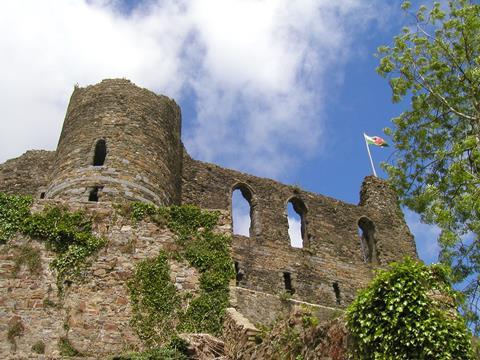
The site is owned by Pembrokeshire council and only a few of the original stone walls remain of the 11th Century castle.
For decades the public has enjoyed open access. The town museum is housed there and the site is used by people to walk their dogs, eat lunch in fine weather and watch occasional events on the grass.
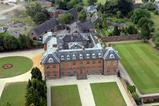
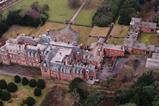
In 2010, Pembrokeshire council announced that it was putting part of the castle site - an old Victorian prison building which for years had been home to the county records office - up for sale.
Last year, an architect and developer showed an interest in turning it into an eight to 16-bedroom boutique hotel and restaurant, but it proved controversial.
Some time later the developer walked away.
The town council decided then that the only way to protect the site for good was to apply for village green status.
It has also put in an offer to buy the Victorian prison building for £50,000.
Pembrokeshire council said the castle grounds had been declared a public open space in 2009 and the town council had the chance to challenge it but failed to do so.
It argues the standing as a public open space means public events in the castle grounds can be organised and managed effectively with the granting of the appropriate licences.
Deputy leader Huw George said village green status would change forever what could be done with the site.
“It will make it very difficult to regulate who uses it and when they use it and that causes us a great concern,” he said.
“Our greatest concern is the objection [against development] they’ve put in, which is by nature flawed.
“The objection I believe should’ve come in 2009 when it was declared a public open space. We’re now in 2013, which seems to me a little bit flawed.”
He added: “By turning it into a village green we curtail many options which may harm the development economically and with tourism in the future, and I think Haverfordwest deserves to have all opportunities left open.”
Both sides are being represented by a solicitor, and the public hearing will be presided over by the Planning Inspectorate.
The castle layout and buildings
The castle stands on a superb, naturally defensive position at the end of a strong, isolated ridge with a sheer cliff on the east. Of the earliest 12th century building, little now survives, except, perhaps for the footings of a large square keep in the north-east corner of the inner ward.
The present form of the castle, divided into two wards, also probably reflects the original plan. It is a little difficult to make out as the museum lies in the centre of the outer ward, while the former prison governor’s house lies on the site of the inner ward gatehouse.
- Much of the existing masonry is late 13th-century in style and may well have been undertaken during the year before Queen Eleanor’s death in 1290.
- The lofty inner ward has round towers on the north-west and south-west corners, while the south-east corner has a square tower with an additional projecting turret.
- The entrance lay on the west, protected by a gatehouse of which no trace survives. The remains of a spacious hall lie on the south, with large windows built high enough in the exterior wall to be safe from attack by besiegers equipped with scaling ladders.
- The south-west and south-east towers have three storeys, the latter with a basement equipped with a postern gate to allow access to a small terrace which could be used to counter-attack during a siege. The wall-walk, carried on a row of corbels on the east of the tower, is a well-preserved feature on the inside, and from the outside of the castle the tower’s remaining lights and arrowslits can be seen.
- The outer ward has lost much of its medieval defences, but the curtain wall survives, albeit in a very rebuilt form, along with most of the north side, with one small semicircular turret and a square tower further east. An outer gatehouse presumably lay near the present entrance on the west. This was the only side with no natural formidable defence.





















No comments yet