If we could put our planetary clock on fast forward, Earth’s surface would writhe with activity. Continents would scurry across the globe, oceans would open and close, and new mountains would shoot up toward the sky.
Yet even as mountains rise, they also periodically sink back down when the stress from tectonic collisions triggers earthquakes. These events happen in a cycle, like the chest of a rocky behemoth drawing uneven breaths, explains Luca Dal Zilio, a geophysicist at the California Institute of Technology.
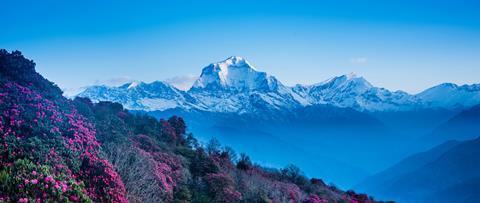
The forces driving this cycle are incredibly complex, and nowhere is that more evident than in the 1,400 miles of jagged peaks that make up the Himalaya. Nailing down the fundamentals underlying this range is vital to understanding the local risk of earthquakes, which threaten hundreds of millions of people living in its shadow.
In a new paper published in Nature Reviews, Dal Zilio and his colleagues have stitched together results from more than 200 past studies of Himalayan geology to lay out the intricate mechanisms behind these geologic respirations—as well as the many challenges that remain.
Since similar geologic “breaths” have been documented around the world, the new work is key to grasping the processes that sculpt many of Earth’s mountain ranges—and figuring out the risks those ranges might also pose. The Himalaya’s lengthy expanse and geologic complexity make it a terrific natural laboratory, says study co-author Judith Hubbard, a structural geologist at Nanyang Technological University in Singapore.
“It’s almost like the Earth is running the experiment for us,” she says.


















2 Readers' comments