The development of ballistic missiles, first used by Germany toward the end of World War II, paved the way for the launch vehicles that would fuel a space race between the Soviet Union and the United States. The space race was then followed by an era of space cooperation, highlighted by the International Space Station.
Humans have always looked up into the night sky and dreamed about space.
In the latter half of the 20th century, rockets were developed that were powerful enough to overcome the force of gravity to reach orbital velocities, paving the way for space exploration to become a reality.
In the 1930s and 1940s, Nazi Germany saw the possibilities of using long-distance rockets as weapons. Late in World War II, London was attacked by 200-mile-range V-2 missiles, which arched 60 miles high over the English Channel at more than 3,500 miles per hour. After World War II, the United States and the Soviet Union created their own missile programs.
Factfile
On Oct. 4, 1957, the Soviets launched the first artificial satellite, Sputnik 1, into space. Four years later on April 12, 1961, Russian Lt. Yuri Gagarin became the first human to orbit Earth in Vostok 1. His flight lasted 108 minutes, and Gagarin reached an altitude of 327 kilometers (about 202 miles).
The first U.S. satellite, Explorer 1, went into orbit on Jan. 31, 1958. In 1961, Alan Shepard became the first American to fly into space. On Feb. 20, 1962, John Glenn’s historic flight made him the first American to orbit Earth.
Factfile
In the 1930s and 1940s, Nazi Germany saw the possibilities of using long-distance rockets as weapons. Late in World War II, London was attacked by 200-mile-range V-2 missiles, which arched 60 miles high over the English Channel at more than 3,500 miles per hour. After World War II, the United States and the Soviet Union created their own missile programs.
On Oct. 4, 1957, the Soviets launched the first artificial satellite, Sputnik 1, into space. Four years later on April 12, 1961, Russian Lt. Yuri Gagarin became the first human to orbit Earth in Vostok 1. His flight lasted 108 minutes, and Gagarin reached an altitude of 327 kilometers (about 202 miles).
The first U.S. satellite, Explorer 1, went into orbit on Jan. 31, 1958. In 1961, Alan Shepard became the first American to fly into space. On Feb. 20, 1962, John Glenn’s historic flight made him the first American to orbit Earth.
In the 1930s and 1940s, Nazi Germany saw the possibilities of using long-distance rockets as weapons. Late in World War II, London was attacked by 200-mile-range V-2 missiles, which arched 60 miles high over the English Channel at more than 3,500 miles per hour. After World War II, the United States and the Soviet Union created their own missile programs.
On Oct. 4, 1957, the Soviets launched the first artificial satellite, Sputnik 1, into space. Four years later on April 12, 1961, Russian Lt. Yuri Gagarin became the first human to orbit Earth in Vostok 1. His flight lasted 108 minutes, and Gagarin reached an altitude of 327 kilometers (about 202 miles).
The first U.S. satellite, Explorer 1, went into orbit on Jan. 31, 1958. In 1961, Alan Shepard became the first American to fly into space. On Feb. 20, 1962, John Glenn’s historic flight made him the first American to orbit Earth.
Landing On The Moon
MoonLanding
This is the caption for the image, it can be quite long.
“Landing a man on the moon and returning him safely to Earth within a decade”
President John F. Kennedy
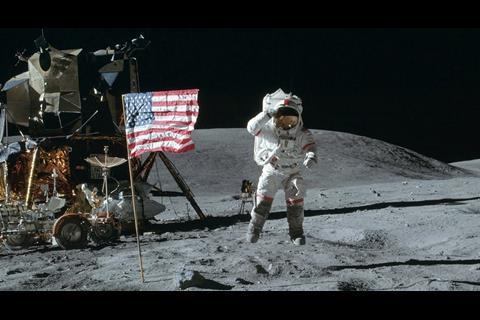
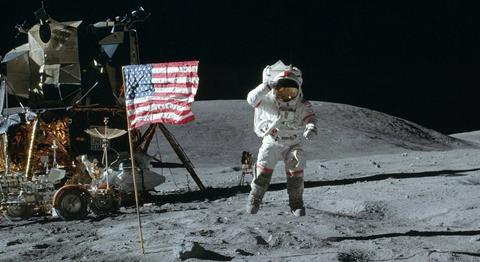
“Landing a man on the moon and returning him safely to Earth within a decade” was a national goal set by President John F. Kennedy in 1961. On July 20, 1969, astronaut Neil Armstrong took “one giant leap for mankind” as he stepped onto the moon. Six Apollo missions were made to explore the moon between 1969 and 1972.
Looking back on my graduation from the US Military Academy on this day in 1951. My time at West Point shaped the rest of my life, and I’m still very proud to say that I graduated 3rd in my class! #Duty#Honor#Countrypic.twitter.com/1EUGZJgPQj
During the 1960s, unmanned spacecraft photographed and probed the moon before astronauts ever landed. By the early 1970s, orbiting communications and navigation satellites were in everyday use, and the Mariner spacecraft was orbiting and mapping the surface of Mars. By the end of the decade, the Voyager spacecraft had sent back detailed images of Jupiter and Saturn, their rings, and their moons.
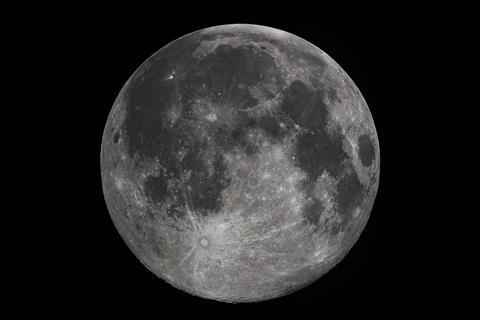
Full Moon
Skylab, America’s first space station, was a human-spaceflight highlight of the 1970s, as was the Apollo Soyuz Test Project, the world’s first internationally crewed (American and Russian) space mission.
In the 1980s, satellite communications expanded to carry television programs, and people were able to pick up the satellite signals on their home dish antennas. Satellites discovered an ozone hole over Antarctica, pinpointed forest fires, and gave us photographs of the nuclear power plant disaster at Chernobyl in 1986. Astronomical satellites found new stars and gave us a new view of the center of our galaxy.
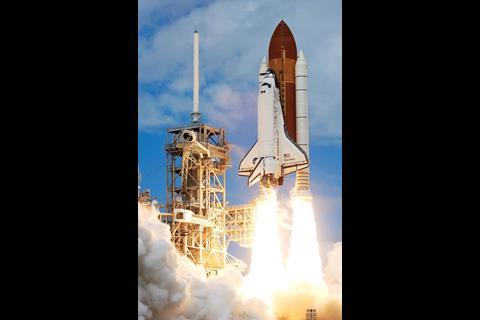
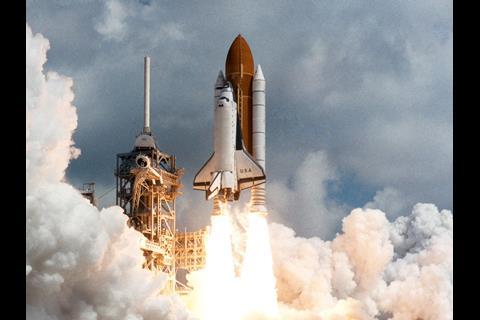
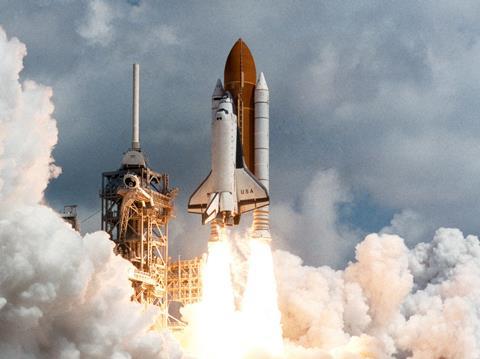
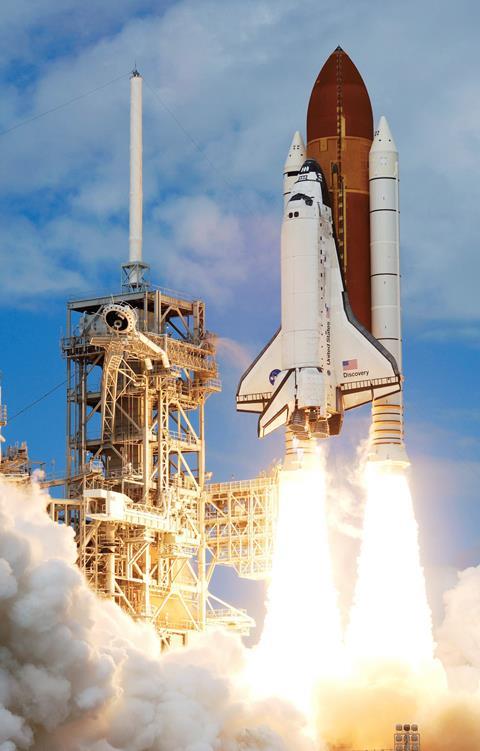
In April 1981, the launch of the space shuttle Columbia ushered in a period of reliance on the reusable shuttle for most civilian and military space missions. Twenty-four successful shuttle launches fulfilled many scientific and military requirements until Jan. 28,1986, when just 73 seconds after liftoff, the space shuttle Challenger exploded. The crew of seven was killed, including Christa McAuliffe, a teacher from New Hampshire who would have been the first civilian in space.
The Space Shuttle takes off
The Columbia disaster was the second shuttle tragedy. On Feb. 1, 2003, the shuttle broke apart while reentering the Earth’s atmosphere, killing all seven crew members. The disaster occurred over Texas, and only minutes before it was scheduled to land at the Kennedy Space Center. An investigation determined the catastrophe was caused by a piece of foam insulation that broke off the shuttle’s propellant tank and damaged the edge of the shuttle’s left wing. It was the second loss of a shuttle in 113 shuttle flights. After each of the disasters, space shuttle flight operations were suspended for more than two years.
Discovery was the first of the three active space shuttles to be retired, completing its final mission on March 9, 2011; Endeavour did so on June 1. The final shuttle mission was completed with the landing of Atlantis on July 21, 2011, closing the 30-year space shuttle program.
The Gulf War proved the value of satellites in modern conflicts. During this war, allied forces were able to use their control of the “high ground” of space to achieve a decisive advantage. Satellites were used to provide information on enemy troop formations and movements, early warning of enemy missile attacks, and precise navigation in the featureless desert terrain. The advantages of satellites allowed the coalition forces to quickly bring the war to a conclusion, saving many lives.
Space systems continue to become more and more integral to homeland defense, weather surveillance, communication, navigation, imaging, and remote sensing for chemicals, fires, and other disasters.
Prototype Space Shuttle Enterprise was rolled out of its assembly facility in Southern California and displayed before a crowd of several thousand people.[95]
Last Atlantis flight and last Space Shuttle flight; STS-135
International Space Station
The International Space Station is a research laboratory in low Earth orbit. With many different partners contributing to its design and construction, this high-flying laboratory has become a symbol of cooperation in space exploration, with former competitors now working together.
The station has been continuously occupied since the arrival of Expedition 1 in November of 2000. The station is serviced by a variety of visiting spacecraft: the Russian Soyuz and Progress; the American Dragon and Cygnus; the Japanese H-II Transfer Vehicle; and formerly the Space Shuttle and the European Automated Transfer Vehicle. It has been visited by astronauts, cosmonauts, and space tourists from 17 different nations.
Space launch systems have been designed to reduce costs and improve dependability, safety, and reliability. Most U.S. military and scientific satellites are launched into orbit by a family of expendable launch vehicles designed for a variety of missions. Other nations have their own launch systems, and there is strong competition in the commercial launch market to develop the next generation of launch systems.
Accordion One
Lorem ipsum and all the restLorem ipsum and all the restLorem ipsum and all the restLorem ipsum and all the restLorem ipsum and all the restLorem ipsum and all the restLorem ipsum and all the rest
Accordion Two
Lorem ipsum and all the restLorem ipsum and all the restLorem ipsum and all the restLorem ipsum and all the restLorem ipsum and all the restLorem ipsum and all the restLorem ipsum and all the rest
The Future Of Space Exploration
Modern space exploration is reaching areas once only dreamed about. Mars is focal point of modern space exploration, and manned Mars exploration is a long-term goal of the
United States. NASA is on a journey to Mars, with a goal of sending humans to the Red Planet in the 2030s.
NASA and its partners have sent orbiters, landers, and rovers, increasing our knowledge about the planet. The Curiosity Rover has gathered radiation data to protect astronauts, and the MARS 2020 Rover will study the availability of oxygen and other Martian resources.
Fun Facts about Space Travel for Kids
One space shuttle launch costs $450 million.
The German V2 was the first rocket to reach space in 1942.
In 1947, fruit flies were launched into space. Scientists wanted to see how they reacted to space travel. Later, in 1949, Albert II, a Rhesus monkey went to space. In 1957, the Russian space dog, Laika, orbited the Earth. Scientists wanted to make sure space travel was safe for humans. Sending animals first gave them valuable information about how bodies react to being in space.
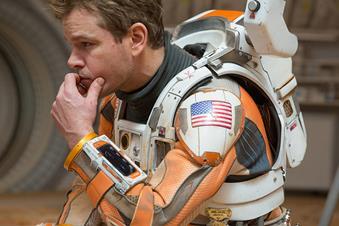
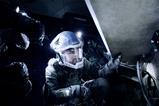
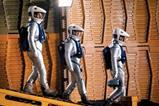
The Martian (both the book and the movie) is a story that’s a realistic and plausible take on a future mission to Mars, and Mark Watney’s space suit is probably one of the most important environments in the story. After being stranded on Mars, he spends a considerable amount of ...
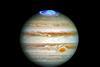
JunoCam is the “citizen science” camera on board Juno. As the spacecraft orbits Jupiter, JunoCam snaps pictures of the planet from different angles and radial distances, targeting features identified in part through the collaborative efforts of the amateur astronomer community.


















No comments yet