













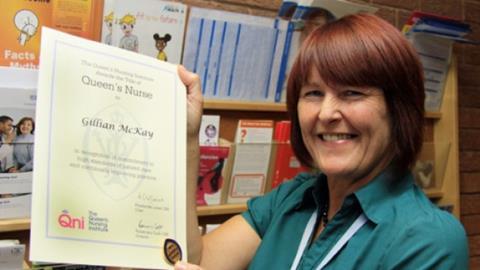

Ruth Thomas won the Queen’s Nurse title after 10 years of work with the Army. She talked to Lucy Jolin about the joys of her job.
When Ruth Thomas walked into a job centre 10 years ago, she never dreamed that she’d find not just a job but a whole new family.
‘I was working for two separate GPs and needed more money,’ she recalls. ‘I walked into the job centre and there was a job for a full-time practice nurse, working in an Army medical centre. The hours suited my junior school age daughter —7.30 am to 4.30 pm Monday to Friday. So I went for it.’
Ruth is still there, dedicated to the ‘boys’ and ‘girls’ of her Regiment, and has just been awarded the prestigious Queen’s Nurse title.
Ruth trained at St Mary’s Hospital in Paddington, 1976. However, she failed her SRN three times, so spent 10 years as an enrolled nurse. In 1991, a senior nursing officer insisted that all the ‘failed finalists’ must re-sit. To Ruth’s surprise, she passed.
Ruth worked in nursing homes around Maidstone, then became a practice nurse in a small dispensing practice. She took her asthma diploma, her practice nursing diploma, and went on to gain her advanced clinical nurse practice degree, graduating with a 2:1 in 2006.
‘The majority of my patients are fit, healthy soldiers and it is my job to keep them that way. I don’t work with families at all. Of course, we see some chronic diseases — even fit young soldiers develop those — but not nearly as many. Because I’m worried about losing my ability to deal with two thirds of the population, I work voluntarily at my old GP practice to keep my hand in with what’s happening with children and older people.’
The challenges of Ruth’s job are very different from those facing practice nurses in general. ‘My boys and girls go to war, and that’s not nice. I could never be married to a soldier because I have to worry about 700 already. I really respect the partners of the soldiers.
‘Half of my regiment are Gurkhas … they are wonderful people. We have the largest ethnic minority group in Maidstone and we are trying to get the Pandit, the Gurkha priest, to teach us Nepali. It would be nice to talk to Gurkhas in their own language, especially when they’re not well.’
Her day-to-day job is full of variety. ‘We have to keep the soldiers up to date with all kinds of immunizations, as they could be sent anywhere in the world with very little notice. We’re a cross between a GP’s surgery, accident and emergency, minor illness and a minor injury surgery — a bit of everything.’
However, Ruth emphasizes that her job is much more than simply doling out medicines. ‘Because I’m 50, the bulk of the Regiment are young enough to be my sons and daughters, so I’m officially “Auntie Ruth”,’ she explains. ‘I get people come in and maybe have a cry because they’ve got no friends, or they’re worried about their boyfriend or girlfriend. You can’t do that in front of your colleagues when you’re a tough soldier. It’s a part of the job that isn’t hands-on practical nursing — it’s nursing by looking after them as a whole.’
Ruth is rarely off duty. She says, ‘I love to walk down Maidstone high street and have people say, “Hello, Ruth” … people bring in photos of their children, or their wedding photos. I’ve been invited to weddings and I’ve been invited to funerals. The regiment is like a family — there is a wonderful sense of belonging.’
She put herself forward for the Queen’s Nurse title as, she says, ‘it’s all about showing that you can do the absolute best for your patients, and that’s what I’ve always tried to do. You hear about the dead and dying, but this is a way we can show we are giving our soldiers the absolute gold standard of care. It’s not just me, either, it’s all the other medical professionals within Army Primary Healthcare Services. We go out of our way to look after our boys and girls.
‘I was so pleased to hear I’d gained the title — I was over the moon. The ceremony was amazing. I’d walked past the Café Royale many times when I was training but as a student nurse it was out of my league! It was wonderful to have Baroness Cumberlege doing the presentation as she’s someone who I had learnt about while doing my prescribing course.’
Although gaining the title has made Ruth think more about using her experience to influence good practice elsewhere, for now she’s very happy to stay with her Regiment.
‘I get very maternal, even though I’m not supposed to,’ she admits. ‘They are my boys. I can see myself looking after my boys until the day I retire—and probably beyond that!’
Downloads
Ruth Thomas Queens Nurse
PDF, Size 56.11 kb





No comments yet