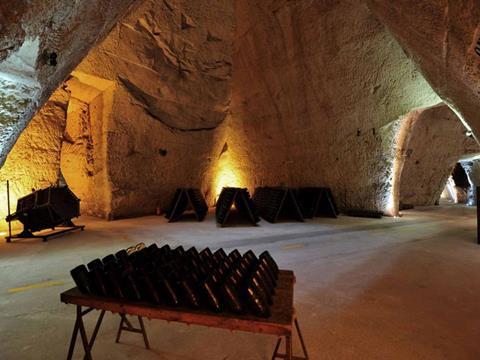
When you are 20m underground in a chalk quarry dug out by the Romans, it’s hard to imagine you’re going to come face to face with the future of anything. Quite the reverse, in fact – it seems like the sort of place where futures end. And yet here I am, in Veuve Clicquot’s limestone cellars, staring at a bottle that may represent the future of this 243-year-old house.
The green glass is at this point unmarked by labels. It is hermetically sealed with the sort of silver metal top you see on stubby bottles of lager, a necessary step before the cork goes in after the sediment goes out. It is indistinguishable from the tens of thousands of other bottles that fill the 24km of caves which reach out like tendrils underneath the champagne town of Reims.
Yet, when its three years of maturation are over in the sloping pupitres [racks] created by the house’s founder, Madam Clicquot, and long after a 60g dosage of sugar has been added, the bottle will be taken away and coated in a reflective, disco-ball silver coating.
Now, anyone familiar with how champagne is made – and marketed – will know that two things are unusual about this. First of all, the amount of sugar that is added in the dosage – your common-or-garden champagne has around 9g; the Richer Veuve demi-sec has 25g. Secondly, and perhaps the more pressing question, when did Veuve start going all disco? Since June, to be exact, when its Veuve Clicquot Rich was released. The company’s president, Jean-Marc Gallot, said at the time, “tradition is good in life, but in this challenging world, we have to push the boundaries”.
And push the boundaries they certainly have. What is really surprising about Rich is that it is made to be mixed with another ingredient, and ice, to make a cocktail – or, as a Veuve winemaker says firmly when I use the c-word, “Rich is for mixology.” The presentation, too, is unusual. When champagne is sold to us it is usually on the basis of the house’s heritage, its obsession with quality, and all accompanied by a cocktail umbrella of holier-than-thou reverence for the fizzing golden stuff. Essentially, it’s marketed as if buying a bottle will suddenly transpose you into an Evelyn Waugh novel.
The real question is, will it change the world of champagne? Probably not. Purists will always want their wine unmolested by fruit and ice and brut champagne is the style du jour, and probably the day after du jour, too. But what Veuve Clicquot Rich and the other styles like it do is open up the world of champagne to a new audience. What its bottle and just about everything else about it is saying is: you can enjoy me on a beach, at 2am in a nightclub or anywhere you choose – you don’t need to worry about posing as a connoisseur, you just need to have a nice time drinking me.
In the world of champagne, where pretentiousness often comes by the case, it is a welcome message.



















No comments yet