In this world of foods that people label as coming from one place when they actually come from somewhere else (like French fries), it’s a relief to find one that actually comes from the country it’s named after, and is really popular there as well. Into this class falls that shining example of sugary goodness, the Belgian waffle – known to French-speakers on its home turf as the gaufre or gauffre, and to Flemish- / Vlaamse-speakers as the wafel, waffel or suikerwaffel. There are many regional varieties, but two specific kinds, made very differently, are the best known
The one most Americans know as a breakfast or dessert dish is the Brussels waffle or gaufre de Bruxelles. The other is the Liège waffle or gaufre de Liège, named after that city and also known in Flemish as the Luikse wafel and in German as theLütticher waffeln.
Neither of these is really thought of that much as a breakfast or brunch dish in Belgium. Where the waffle really shines in Belgium is as street food – something you buy from a bakery or street stand, and eat out of hand, hot. (There is so much of this going on that there are lots of places, especially in the big cities, where you’ll see signs begging people not to bring waffles into shops or stand around eating them out in front and blocking the view through the windows.)
Brussels Waffles
The waffle that most North Americans would think of as a Belgian waffle is known in Belgium as gaufre de Bruxelles, “the Brussels waffle”. General Belgian affection for it is sufficiently great that this waffle was chosen as one of the Belgian national “birthday cakes” for the European Union’s fiftieth birthday celebrations.
The Brussels waffle is based on a batter raised with yeast – as opposed to most North American waffle or pancake batters, which are raised with baking powder. And this is where many North American attempts at the Brussels/Belgian waffle fall down: the yeast raising changes the chemistry of the batter, producing a tenderer crumb in the finished waffle than a baking-powder raising can.
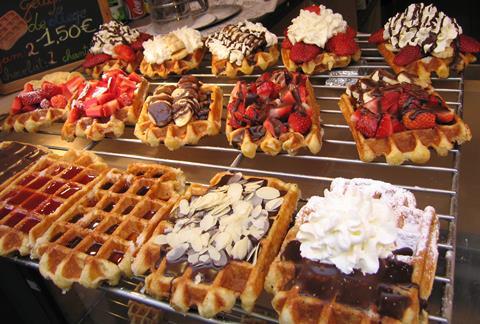
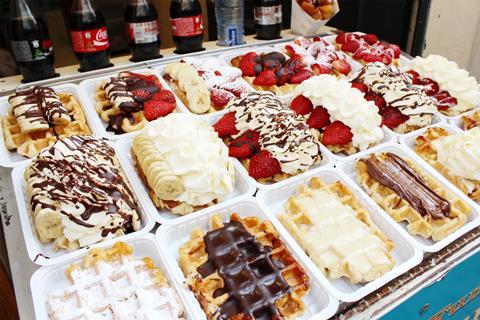
The yeast and the beaten egg whites which are folded into the batter work together to produce a light crisp waffle. The Brussels waffle is rectangular and usually about an inch thick, with fairly deep “dimples”. When you buy it on the street or in a shop in Belgium, it usually comes dusted with a little confectioners’ sugar / icing sugar, and maybe spread with chocolate or thick whipped cream. But you can also get it piled high with fruit and other goodies.
Liege Waffles
The Liège waffle, named after that city, is also known as the Luikse wafel in Vlaamse and as Lütticher waffel in German. It’s oblong, more or less oval-shaped, a thinner and smaller waffle than the Brussels waffle. But it’s also more substantial, based more on a dough than a batter, and has a significant crunch due to the small nuggets ofparelsuiker or “pearl sugar” that are added to the dough just before baking. These bits of sugar melt when being baked on the waffle iron and caramelize, producing a sugary crust like what’s found on top of a creme brulée.



















1 Reader's comment