China is regarded as a reliable customer for oil due to soaring local consumption, but, in recent years, it has also emerged as a global operator and provider of oil-related services.
China is the world’s second-largest oil consumer behind the United States, and the largest global energy consumer, according to the International Energy Agency (IEA). The country was a net oil exporter until the early 1990s and became the world’s second-largest net importer of oil in 2009. China’s dependence rates on imports of oil and natural gas came in at 58% and nearly 30%, respectively, in 2012, according to a report by the Economics and Technology Research Institute of China National Petroleum Corporation (CNPC).
Though the country is one of the biggest oil and gas consumers, it is considered a small consumer per capita, and coal remains its main source of energy. In 2012, coal—at 3.98 billion short tons—accounted for 70% of China’s energy use. “For example, gas consumption per capita in 2010 was 80 m3 per person in China, compared to 2176 m3 in the US and 457 m3 per person in the world,” said Yan Cunzhang, president of China National Petroleum Corp’s (CNPC) foreign development department.
Cunzhang said that oil and gas’s share in China’s energy consumption mix will continuously increase, adding that China’s national oil companies play a leading role in China’s petroleum industry and that China is moving away from subsidizing energy-related products. “China is transforming its oil and gas pricing from government-dominant to market-dominant,” said Cunzhang.
Deepwater discoveries
| Field | Operator | Location | Water Depth (m) | Status | Production start |
|---|
| GlobalData, operators |
| Kikeh |
Murphy Oil |
Sabah |
1300 |
Production |
2007 |
| Gumusut- Kakap |
Shell |
Sabah |
1100 |
Production |
2012 |
| Malikai |
Shell |
Sabah |
480 |
Development |
2014/5 |
| Kebabargan |
KPOC |
Sabah |
100 to 400 |
Development/ Appraisal |
2014 |
| Kamunsu |
KPOC |
Sabah |
100 to 400 |
Development/ Appraisal |
2014 |
| Slakap- North Petal |
Murphy |
Sabah |
1300 |
Development |
2013 |
| Rotan |
Murphy |
Sabah |
over 1000 |
Development |
2016 |
| Biris |
Murphy |
Sabah |
over 1000 |
Development |
2016 |
| Dolfin |
Murphy |
Sabah |
over 1000 |
Development |
2016 |
| Jangas |
Murphy |
Sabah |
over 1000 |
Pre-Development |
NA |
| Ubah Crest |
Shell |
Sabah |
over 1000 |
Pre-Development |
NA |
| Pisangan |
Shell |
Sabah |
over 1000 |
Pre-Development |
NA |
| Limbayaong |
Shell |
Sabah |
over 1000 |
Pre-Development/ Appraisal |
NA |
| Wakid |
Petronas |
Sabah |
over 1000 |
Pre-Development |
NA |
Other major Chinese national oil companies include China National Offshore Oil Corp (CNOOC) and China Petroleum and Chemical Corporation (Sinopec).
Deepwater discoveries
| GlobalData, operators |
| Field |
Operator |
Location |
Water Depth (m) |
Status |
Production start |
| Kikeh |
Murphy Oil |
Sabah |
1300 |
Production |
2007 |
| Gumusut- Kakap |
Shell |
Sabah |
1100 |
Production |
2012 |
| Malikai |
Shell |
Sabah |
480 |
Development |
2014/5 |
| Kebabargan |
KPOC |
Sabah |
100 to 400 |
Development/ Appraisal |
2014 |
| Kamunsu |
KPOC |
Sabah |
100 to 400 |
Development/ Appraisal |
2014 |
| Slakap- North Petal |
Murphy |
Sabah |
1300 |
Development |
2013 |
| Rotan |
Murphy |
Sabah |
over 1000 |
Development |
2016 |
| Biris |
Murphy |
Sabah |
over 1000 |
Development |
2016 |
| Dolfin |
Murphy |
Sabah |
over 1000 |
Development |
2016 |
| Jangas |
Murphy |
Sabah |
over 1000 |
Pre-Development |
NA |
| Ubah Crest |
Shell |
Sabah |
over 1000 |
Pre-Development |
NA |
| Pisangan |
Shell |
Sabah |
over 1000 |
Pre-Development |
NA |
| Limbayaong |
Shell |
Sabah |
over 1000 |
Pre-Development/ Appraisal |
NA |
| Wakid |
Petronas |
Sabah |
over 1000 |
Pre-Development |
NA
|
China’s crude oil output has grown from 2.11 million B/D in 1980 to 4.42 million B/D in 2012, according to US Energy Information Administration (EIA) data. This is amid maturing domestic fields. At the same time, China’s demand for oil climbed from 1.76 million B/D in 1980 to 3.36 million B/D in 1995. It then leapt to 4.36 million B/D by 1999.
By 2003, China’s oil demand was up to 5.58 million B/D—then almost doubled to 10.28 million B/D in 2012. So China’s demand for oil is now around 2.3 times greater than its output—a shortfall of 5.86 million BOPD.
The shortfall alone is equal to the combined 2012 oil demand of India (3.62 million B/D), the UK (1.50 million B/D), Pakistan (440,000 B/D), and the Philippines (302,000 B/D)—and slightly less than one-third of US oil demand (18.55 million B/D).
And China’s oil demand continues to grow at an estimated rate of 4% a year, according to EIA energy forecasts for 2013 and 2014. This represents an increase of around 410,000 B/D in 2013 and 428,000 B/D in 2014.
Amid growing demand, China aims to boost investment in exploration of oil and gas resources, which reached USD 13.07 billion (CYN 80 billion) in 2013, according to China’s Ministry of Land and Resources. Such investment has risen steadily in China over the past several years as the country moves to reduce dependence on imports.
Ministry figures show that money spent on exploration of oil and gas fields rose from USD 3.11 billion (CYN 19.0 billion) in 2002 to USD 11.04 billion (CYN 67.3 billion) in 2011. In the 2008–2011 period, some 5.01 billion tons of petroleum reserves and 2.6 Tcm of natural gas were discovered.
Onshore: Enhancing Output
China’s largest oil fields are mature and production has peaked, leading companies to focus on developing largely untapped reserves in the western interior provinces and offshore fields.
China holds 25.6 billion bbl of proven oil reserves as of 2013, up over 9 billion bbl from 2009 and the highest in the Asia Pacific region, according to EIA data. China’s largest and oldest oil fields are located in the northeast region of the country. The country produced an estimated 4.4 million B/D of total oil liquids in 2012, of which 95% was crude oil. In 2012, China’s oil production was forecast to rise by about 170 thousand B/D to nearly 4.6 million B/D by the end of 2013. Over the longer term, the EIA predicted a flatter incline for China’s production, reaching 4.7 million B/D by 2035.
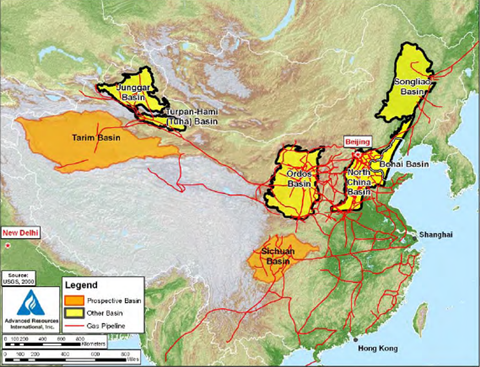
According to a September 2012 analysis report on China by the EIA, roughly 85% of Chinese oil production capacity is located onshore, primarily in mature fields. Although offshore E&P activities have increased substantially in recent years, China’s interior provinces, particularly in the northwest’s Xinjiang Uygur Autonomous Region and central Ordos basin, have also received significant attention. In 2012, China announced its plan to make Xinjiang into one of the country’s largest oil and gas production and storage bases by 2015.
Much of China’s crude oil production upside will come from increased output from fields yet to reach peak capacity, such as Tarim. The onshore Junggar, Turpan-Hami, and Ordos basins have all been the site of increasing E&P work, and the Tarim basin in the northwest has been a key focus of new onshore oil prospects.
Crude oil production from Sinopec and PetroChina’s interests in Tarim grew 4% annually to 261,000 B/D in 2011, according to IHS Global Insight. PetroChina intends to boost oil production in the Junggar basin, one of Xinjiang’s oldest basins, from 218,000 B/D in 2011 to 400,000 B/D in 2015 by using more cost-effective and advanced oil extraction techniques for heavy oilfield development.
Currently, 15% of China’s overall oil production comes from offshore. A third of its current reserves are offshore and of these, 33% are in the South China Sea, most in deep water.
Offshore China E&P activities to date have focused on the Bohai Bay region, Pearl River Delta, South China Sea, and, to a lesser extent, the East China Sea. The Bohai Bay basin, located in northeastern China offshore Beijing, is the oldest oil-producing offshore zone and holds the bulk of proven offshore reserves in China.
Offshore zones have also received increasing attention for upstream natural gas development in China, particularly in the South China Sea. Discovering additional gas reserves will be critical to the Chinese government’s plan to increase the use of natural gas in generating electric power.
As in other regions of the world, Chinese E&P companies are turning to deep water to find more oil and gas reserves.
In June 2006, CNOOC (51%) and Husky Energy (49%) announced the country’s first deepwater natural gas discovery in the Liwan 3-1 gas field, located in Block 29/26 in the South China Sea, about 300 km southeast of Hong Kong. Development of the block is called the Liwan Gas Project. Contingent reserves are estimated at between 4 and 6 Tcf of natural gas. CNOOC and Husky have signed an agreement whereby Husky will operate the deepwater portion of the Liwan-3 field, including development drilling and completions, subsea equipment and controls, and subsea tie-backs to a shallow-water platform. CNOOC will operate the shallow-water infrastructure, including the platform, subsea pipeline to shore, and the onshore gas processing plant. First gas production is anticipated in early 2014.
The Liuhua 34-2 field, also in Block 29/26, is being developed in parallel with the Liwan 3-1 field and is scheduled to be tied into the Liwan infrastructure during an estimated 8-week period in the second half of 2014. A third field on the same block, Liuhua 29-1, will also be jointly developed by CNOOC and Husky.
Each year, CNOOC offers at least a dozen offshore blocks to foreign partners via tender. Few parties have responded because information is lacking about the quality of the assets. Also, foreign companies generally pay for all exploration and development costs in China—drilling one deepwater well can cost USD 1 billion or more—and cannot own more than a 49% working interest. Since 2005, only nine offshore blocks have been selected through CNOOC’s annual tender for development in China, according to a Wall Street Journal analysis.
In early October 2013, and in order to boost its offshore investments, CNOOC invited foreign companies to bid on an unprecedented number of deepwater blocks off Chinese shores in an attempt to boost domestic oil output.