














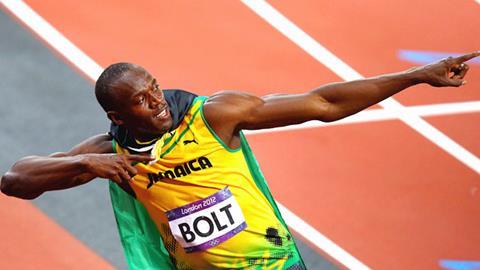
It took just 9.69 seconds for Usain Bolt to become one of the most famous men on the planet.
The Jamaican sprinter’s breezy running style seized gold in the 100m at the 2008 Beijing Olympics, destroying the world record and leaving his rivals to fight for second. As he sauntered over the line, one shoelace undone and a smile on his face, having slowed down to begin his celebrations early, the world was won over. It was, quite simply, one of the most extraordinary moments in sport.
Days later, he won gold in the 200m and sprint relay. A year later, he beat his own 100m record—in 9.58 seconds.
Now, as the London Games approach, we have the prospect of watching him all over again. He’s determined to defend his Olympic titles to become a “legend”, he says, only this time he promises to be faster—maybe winning the 100m in 9.4 seconds.
Experts have debated whether this is possible, and Olympic rival and Saint Kitts and Nevis sprinter Kim Collins reckons the speeds Bolt reaches are already ridicu-lous. “Come on,” he’s said. “How fast can you go before records can’t be broken?”
But Bolt holds world records in the 100m, 200m (19.19 seconds) and 4x100m relay (37.1 seconds), despite breaking all the rules. Experts reckon that the ideal height for a sprinter is 5ft 11ins to 6ft 1in, yet Bolt is 6ft 5ins—and, with size 13 feet, it’s very hard for him to get the speedy starts enjoyed by his competitors. He was born with scoliosis (curvature of the spine), so one leg is half an inch shorter than the other. He famously eats chicken nuggets and refuses the protein shakes that dominate the diets of his rivals.
“I can tell you what I did today,” he told a packed press conference straight after his 100m triumph in 2008. “I woke up at, like, 11am, sat around and watched some TV, had lunch, some nuggets, then pretty much went back to my room, slept again…got some more nuggets. Then I came to the track.”
“Sometimes I’d look at that stopwatch and think, there’s something wrong with this watch. No kid can run that quickly”
School PE teacher Dwight Barnett
The world of sports science shuddered, but the rest of the world applauded. It was refreshing to be talking about a man’s natural talent and not his crowded training schedule. And it left everyone with the feeling that he won without testing the limits of his ability.
Usain St Leo Bolt was born on August 21, 1986, in Relawny, Jamaica — an area known for its sugar plantations and yams. He grew up with his grocer father Wellesley, his mum Jennifer, his half-sister Christine and half-brother Sadiki. His parents spent much of their time trying to contain their hyperactive elder son by sending him on errands and encouraging his love of sport. At one stage, Wellesley was so worried about Usain that he took him to the doctor to see if there was something wrong. “Turns out I was just lively,” says Bolt.
His talent for cricket won him a sports scholarship to William Knibb High School, where PE teacher Dwight Barnett noticed his speed around the pitch and urged him to focus on track and field.
“Sometimes I’d look at that stopwatch and think, there’s something wrong with this watch. No kid can run that quickly,” Barnett has said. At 12, Bolt ran 52 seconds flat for the 400m on a grass track (quick enough to qualify for this year’s Olympic women’s event). But, despite his ability, he hated training and admits that he his in the local games arcade to avoid it.
Still, he won a 200m silver medal at the Jamaican Champs tournament, aged just 14. And, at 15, he became the youngest ever male world junior champion, when he ran 20.61 seconds.
“[Winning] changed my whole life because, after that, I was like, Why should I worry? I haven’t worried since”
“I’ve never been so nervous in my whole life,” he recalled recently of the build-up to the race. “I was shaking because everybody was expecting me to win or get a medal. I even put my spikes on the wrong feet. [Winning] changed my whole life because, after that, I was like, Why should I worry? I haven’t worried since.”
After the win, great things were expected from Bolt, but a combination of injuries and ill-discipline led to failure at the 2004 Athens Olympics — he was eliminated in the first round of the 200m. Disillusioned, he knew things had to change. He turned to Glen Mills, a Jamaican coach who’d worked with Kim Collins, and told him he wanted to be the best and take up a new event: the 100m. Mills new he had to fix Bolt’s attitude to make him a great, but as the sprinter’s confidence and trust in him grew, he started training harder and kept himself out of nightclubs and on the track. All the hard work paid off in Beijing.
Today, with no woman currently in his life, Bolt lives with Sadiki and Nugent Walker Jnr (“NJ”), his best friend since primary school, in a five-bedroom mansion in Kingston, Jamaica. Bolt has a chef to keep his diet on the straight and narrow, and a regular cleaner. “If she didn’t come, the house would fall down,” he says.
One of his biggest problems is losing things. He once left his Olympic golds in a New York hotel, and found his World Championship medals in his wardrobe after a year of searching. They’re in a bank vault now.
He enjoys socialising. Guiness is his drink.
Downloads
Men's 100m records
PDF, Size 0.13 mb

No comments yet