


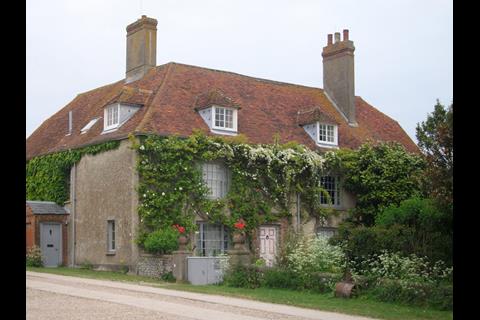
Charleston, the country home of the Bloomsbury Group is a unique example of Vanessa Bell and Duncan Grant’s decorative style within a domestic context and represents the fruition of over sixty years of artistic creativity. Vanessa Bell wrote of this time; “It will be an odd life, but…it ought to be a good one for painting.”
In addition to the house and artists’ garden, there is an exhibition gallery showing an exciting mix of contemporary and historical shows of fine and decorative art, a Crafts Council selected shop selling applied art and books relating to Bloomsbury, a small tea room and a video presentation. Charleston hosts a number of special events throughout the year, most notably the Charleston Festival which is centred around talks and drama relating to literary, artistic and Bloomsbury themes.
It’s most lovely, very solid and simple, with…perfectly flat windows and wonderful tiled roofs. The pond is most beautiful, with a willow at one side and a stone or flint wall edging it all round the garden part, and a little lawn sloping down to it, with formal bushes on it.
Vanessa Bell
In 1916 the artists Vanessa Bell and Duncan Grant moved to Sussex with their unconventional household. Over the following half century Charleston became the country meeting place for the group of artists, writers and intellectuals known as Bloomsbury. Clive Bell, David Garnett and Maynard Keynes lived at Charleston for considerable periods; Virginia and Leonard Woolf, E.M. Forster, Lytton Strachey and Roger Fry were frequent visitors. Inspired by Italian fresco painting and the Post-Impressionists, the artists decorated the walls, doors and furniture at Charleston. The walled garden was redesigned in a style reminiscent of southern Europe, with mosaics, box hedges, gravel pathways and ponds, but with a touch of Bloomsbury humour in the placing of the statuary.
The rooms on show form a complete example of the decorative art of the Bloomsbury artists: murals, painted furniture, ceramics, objects from the Omega Workshops, paintings and textiles. The collection includes work by Renoir, Picasso, Derain, Matthew Smith, Sickert, Tomlin and Delacroix.
2010 marked the centenary of the birth of Quentin Bell, the second son of Clive and Vanessa Bell.
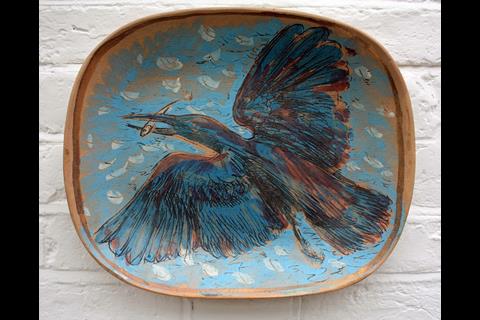
Quentin Bell’s pottery
Quentin Bell was 6 years old when he moved to Charleston with his mother and older brother, Julian, in the middle of World War I. Charleston remained a home for him, on and off, until he married in 1952.
His education was sporadic, and after spending a number of years training as an easel artist, he began to study pottery at the age of 25. For this he went to Stoke on Trent, an internationally renowned centre for ceramics also known as the potteries or the five towns. His passion for working with clay remained with him for life. He created this pottery when the family came to live here permanently during World War II.
Quentin Bell worked in a number of fields throughout his life. As well as being a practising artist and potter, he lectured in Fine Art at Newcastle and Sussex Universities and became a Professor of Art History and Theory at Sussex. He wrote prolifically, and his published work includes books on the history of fashion, essays on Ruskin and on the nature of art history and criticism. Most famous though, is his celebrated biography of his aunt, Virginia Woolf, researched with the help of his wife, Anne Olivier Bell.
Quentin Bell became a driving force behind the creation and survival of the Charleston Trust, working tirelessly for Charleston until his death in 1996.
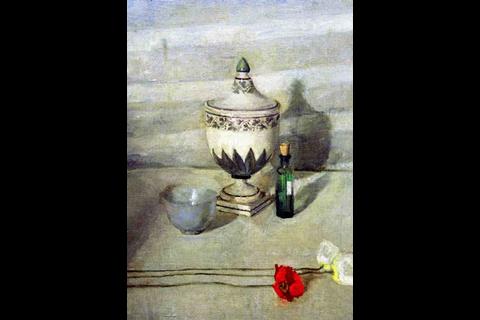
Icelandic poppies
The Charleston Trust is delighted to announce the acquisition of Vanessa Bell’s painting Iceland Poppies through the generous support of The Heritage Lottery Fund, The Art Fund and a number of private donors. During 2007 we hosted a full programme of events and workshops to celebrate the acquisition.
Downloads
SKA Factsheet for Engineers
PDF, Size 1.14 mb
No comments yet